
A creosote bush can look like a weed that happens to tolerate heat. Spend a year with one, and the shrub starts to look like a clock. The leaves are small, thick, and paired. After a real rain they give off the sharp resin smell that people use as the name of the whole desert. A lone shrub with one woody crown is often a young plant. A ring of shrubs around a bare center is usually not a grove of neighbors. It is one plant that has been replacing itself from the outside while the middle dies.
Frank Vasek worked this out in the Mojave and published the account in 1980. Creosote clones grow by uneven radial spread. A stem segments. New stems come up at the outer edge of the living pieces. The center, which is the oldest wood, dies and rots, so the clone becomes a ring with an empty middle. Old rings stretch into ellipses. Some are longer than 20 meters. The living stems you can put a hand on are not thousands of years old. The genetic individual, the clone, can be. Vasek was careful about that distinction, and any honest note should keep it.
How the age was estimated
He did not count eleven thousand annual rings on one trunk. Creosote wood does not offer that kind of diary, and the original trunk is gone. He measured how fast living plants add radius, and he compared that pace with radiocarbon ages of dead wood still buried inside rings. Seedlings in his samples added about 0.73 millimeters of radius a year. Young clones added about 0.82 millimeters. Wood that had been dated with radiocarbon implied about 0.66 millimeters a year. Those three numbers sit close together, which is why the extrapolation is not a guess pulled out of the air. The largest clone he treated had an average radius of 7.8 meters. Divide that distance by a growth rate near two-thirds of a millimeter a year, and the age approaches 11,700 years. He also wrote the sentence that popular accounts often drop. If the growth rate was faster in some past centuries, that clone is younger than the headline. The ring is ancient either way. The last digit is not a birth certificate.
| What was measured | Rate or size | How to read it |
|---|---|---|
| Seedling radial growth | about 0.73 mm per year | Living seedlings, from wood increments |
| Young-clone radial growth | about 0.82 mm per year | Living clones, same method |
| Radiocarbon-dated wood | about 0.66 mm per year | Dead wood still inside rings |
| Largest clone | average radius 7.8 m | Age may approach 11,700 years only if that rate held |
| Ordinary seedlings | average ages about 19 to 60 years | The oldest seedling he counted was 89 |
Most creosote bushes are not King Clone. Vasek's own age spread for ordinary seedlings ran from the teens of years into about sixty, and the oldest seedling he measured was 89. A person who walks off a road and announces that every shrub is older than agriculture is repeating a brochure, not looking at the plant. Big rings are uncommon. They need a long time without the soil being stripped or the water regime being rewritten. A creosote on a graded shoulder, or one that came back after a fire, is living on a short clock even if its leaves look identical to the leaves on an old ring.
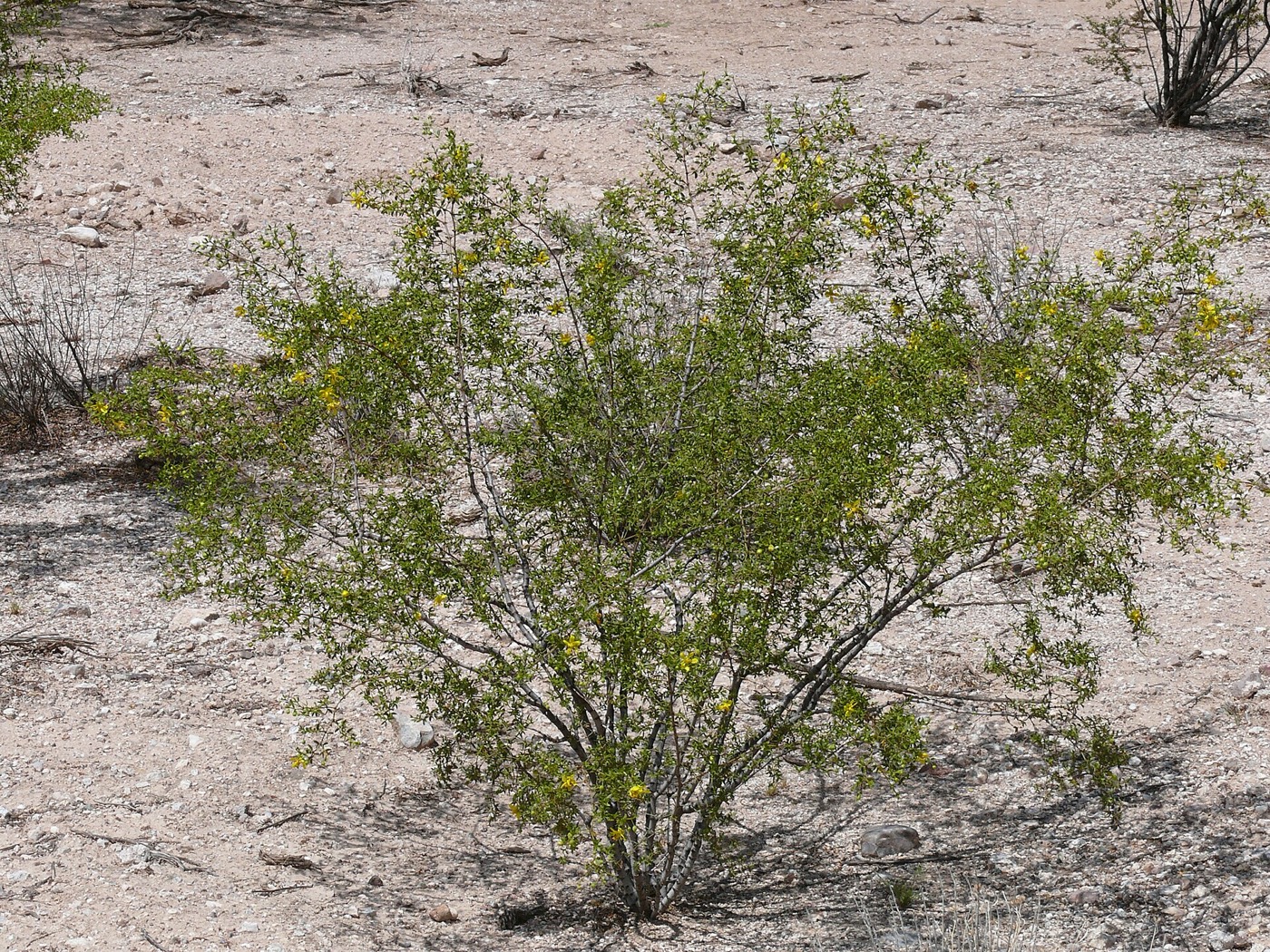
The geometry is something you can see without a laboratory. Stand where you can look down on the shrub, not only into it. A young plant is a knot of stems on one root crown. A middle-aged clone is a broken circle, with gaps where a segment died and has not been replaced. An old clone is a wide, often uneven ring, and the ground in the middle can be bare enough to pitch a small camp, which is a bad idea and also the wrong scale for respect. The bare center is not a mysterious clearing kept empty by a poison halo. It is the place where the original wood has already rotted away. New stems stand at the perimeter because that is where the living margin is.
The rain that actually matters
Leaves and rings are only half the clock. The other half is water, and in the Mojave the important water is not the dramatic summer thunderstorm that makes a road shine for twenty minutes. Janice Beatley followed phenology there for years and tied the events to storms rather than to the names of months. A heavy rain, more than about 25 millimeters, about an inch, is the size that can start growth. The rain that matters most is a regional one between late September and early December. That autumn soaking is usually what winter annuals need if they are going to grow and flower in the following winter and spring. It is also, in most years, what the shrubs need if their next spring is going to be a real growing season rather than a holding pattern. Light rain that wets the dust and is gone by noon usually does not count. The desert is full of those rains. They are weather. They are not the phenological trigger.
This is why a green March can be decided in October, and why a notebook that starts in March is late. Beatley's flow of events runs autumn, winter, spring. Summer is not empty. Under some conditions a rain in another season can start local growth, including a flush of summer annuals in a wash that held water. Those are exceptions with their own rules, not a second copy of the winter calendar. If you mix the two floras in one sentence, "the desert bloomed," you have erased the only fact that makes the year intelligible.
Winter annuals and the creosote shrub are using the same rain and living opposite lives. The annual spends almost all of its time as a seed and risks a few weeks of leaves. The shrub stays visible, with a deep and wide root system, small leaves, and resin. Creosote is not a cactus. It does not run the night-time carbon trick that many succulents use. Its leaves work in the day and pay for that with tight control of water loss, drought deciduous habits when the year is bad, and the ability to sit, looking almost unchanged, through months that would finish a softer plant. When people say the desert is doing nothing, they are often looking at a shrub that is deliberately not spending.
Bare ground, crust, and the toxin story
Between the shrubs the ground is often empty of other large plants. An old story says creosote poisons its neighbors with chemicals washed out of the leaves, and that the bare disks are a chemical moat. Some laboratory extracts of creosote tissue can slow the growth of seedlings in a dish. That is not the same result as a moat in the field. Roots of a mature creosote occupy the soil widely and take the water that a brief rain puts into the top layer. A seedling of anything, including another creosote, is competing with a plant that is already there and already connected to deeper moisture. Where experiments have separated the chemical idea from the root-and-water idea, water and roots explain more of the bare ground than a permanent toxin. The honest sentence is narrower. Creosote chemistry is real and the resin is not a perfume. It is a poor explanation for every empty circle you see from the road.
What the empty-looking soil often does contain is a biological crust. Jayne Belnap's reviews of dryland crusts describe a thin community of cyanobacteria, algae, lichens, and mosses that binds the surface, slows wind erosion, and fixes nitrogen in a place where nitrogen is scarce. The crust is easy to miss because it looks like dirt with a slightly darker, lumpier top. It is also easy to destroy. A boot, a tire, or a herd cuts it. Recovery is not a season. In the driest sites it can be decades, and the cyanobacterial filaments that hold the grains together do not reappear because someone wishes the tracks would fade. A field note that says "bare soil" should say whether the surface was a crust, a track, a wash, or pavement. Those are four different places.
Fire is a new rule
Creosote shrubland did not grow up with frequent fire. The shrubs are spaced, the native annuals do not stay as standing fuel, and a lightning strike often has little to carry it. Invasive annual grasses, notably red brome, change that arithmetic. They fill the gaps with a fine fuel that cures early and carries flame from shrub to shrub. A fire that the old spacing would have dropped now runs. Creosote can resprout after some burns and it can reseed, but it does not thrive on a short fire return the way a chaparral shrub does. The years after a grass-fueled fire are often more grass, because the grass is ready to use the open ground and the nitrogen pulse, and the next fire arrives sooner. Matthew Brooks and others have laid out this loop for the Mojave and the wider desert Southwest. It is one of the few changes you can see in a single decade if you revisit the same valley. The shrubs get fewer. The fuel gets finer. The rings that took centuries to form do not have centuries to rebuild between fires.
A notebook is useful here if it is dull on purpose. Record whether the interspaces are native annuals, a crust, or a continuous straw of brome. Record whether dead shrubs are standing from drought or blackened from fire. A photograph of one green creosote does not tell you which of those valleys you are in.
How to look at one plant
Pick one shrub and give it a page, not a glance. Sketch the outline from above: dot, arc, or ring. Pace the longest diameter and write the number in steps if you have no tape. Note whether the center is crust, gravel, or a heap of old dead stems. Look at the leaves. After a triggering autumn rain, creosote leafs out and flowers on a schedule you can actually watch, small yellow blossoms and then fuzzy fruit. In a year when the autumn rain failed, the same shrub may keep a thin set of old leaves and add almost nothing. That contrast, on the same plant, is worth more than a new species for the list.
Write the rain you actually saw, and do not pretend it was the rain that mattered if you were not there in October. "Soil dark for an hour on 3 March" is a true note. It is not Beatley's trigger. If you can, add whether water stood in the wash or ran off the pavement. Annuals will answer that difference even when the shrub looks the same from the road.
Do not dig up a ring to see the dead wood. The dating work already required wood from inside clones, and it is not a souvenir project. The living margin is the part the desert is still using. Leave it. The same goes for driving across crust to get a better angle on a ring. The photograph is not worth the track, and the track will still be there when the photograph has been cropped.
A year, written as a method
Imagine following one roadside creosote and the wash beside it, without inventing measurements you did not take. In late summer the shrub is the dull green of a plant that is spending as little as possible. Summer storms may drop a local flush of annuals in the wash and leave the pavement between shrubs unchanged. If you only visit then, you will think the desert has two species and a lot of gravel.
Come back after a heavy rain in October or November, if one comes. The smell is the first record, then new leaves, then buds. Winter is slow growth, not a blank. Beatley's winter annuals germinate on that autumn water and sit as small rosettes through the cold, which is a dangerous time and also the time when evaporation is low enough for a seedling to exist. Spring is the visible payoff: flowers on the shrub, flowers on the annuals, and then, quickly, seed. By early summer the annuals are straw, and the shrub is back to holding. A second visit in June that finds only straw has not found a failure. It has found the end of a season that started seven months earlier.
If the autumn rain does not come, write that down with the same care. The absence is the result. Spring will be thin. People who arrive in April and call the valley dead have often missed a year that was decided in November. Your page for that shrub should be allowed to say "no new growth," which is a complete observation.
What a green spring is not
A superbloom is a withdrawal from the seed bank and a good year for the shrubs, not a change of biome. The flowers do not mean the water table has recovered, and they do not mean the fire problem has paused. Invasive grass can have a superbloom of its own, and that one builds fuel. Native annuals spend seed and leave crust and gravel. If your note does not separate those two carpets, the pretty year and the dangerous year look the same in the photograph.
Creosote will still be the plant you see on the drive home. That reliability is the trap. The shrub is good at looking present while the year, the crust, and the clone are doing different things. The ring may be older than the town at the highway exit. The stem you touch is not. The rain that made the flowers may have fallen before you bought the notebook. None of those facts is hidden. They are just not in the single frame of a green bush against a blue sky.
Write the frame anyway, and then write the three lines that the frame cannot hold: the shape of the plant from above, the season of the last heavy rain if you know it, and what is in the spaces between shrubs. A desert that is watched that way stops being a backdrop. It becomes a set of clocks, running at different speeds, on the same gravel.
Roots, seedlings, and the first hard years
A creosote seedling is not a small version of the ring. It is a gamble that the clone, once established, no longer has to make. The seed germinates when the surface stays wet long enough, which in practice means the same heavy, cool-season rains that wake the annuals. The seedling then has to push a root down before the top few centimeters turn to dust again. Most do not. The ones that do often sit in the shade of another shrub for the first seasons, not because the desert is kind, but because a nurse plant slows the wind, drops a little litter, and takes the edge off the noon sun. The nurse can be a bursage, a dying shrub, or even a creosote that is not yet a closed ring. The relationship expires. The young creosote's roots spread, and the helper is no longer a helper. If you only map adult shrubs, you miss the decade when the pattern was decided by who germinated under whom.
Roots are also why the plant can look idle. A large creosote draws on a wide volume of soil, including moisture that never shows as a puddle. After a light rain the leaves may not change at all, because the plant is not organized around puddles. After the autumn trigger, the same root system funds a flush of leaves and flowers that seems sudden if you did not see the rain. The suddenness is yours. The shrub has been connected to that soil the whole time.
Flowers, fruit, and what the bees are doing
Creosote flowers are small and yellow, five-petaled, easy to walk past if you are looking for a cactus bloom. They matter because they are the moment the clone does something other than persist. A ring can expand for centuries by stems alone. Flowers are how a new genetic individual starts somewhere else. Bees, including specialist bees that time their season to this shrub, move pollen among plants. The fruit is a fuzzy white ball that breaks into segments, each with seeds. Those segments do not fly across the county. They move by gravity, by water in a wash, and by animals that brush the shrub. A clone that is eleven thousand years old and a seedling that is eleven months old can stand in the same view. Only one of them is news. Both of them are the species.
If you are keeping dates, the useful flower notes are dull: first open flower, peak, and the week the fuzzy fruit is obvious. Compare those dates with the autumn rain, not with a festival calendar. In a year when the trigger failed, write "no flowering" and do not fill the gap with a memory of last year. Phenology that borrows from memory is fiction.
Bursage, pavement, and the wash
Creosote rarely holds the desert alone. White bursage is the classic neighbor on many Mojave fans, smaller, grayer, and often the plant that fills the middle distance. The two are not interchangeable. Bursage is more likely to die back hard in a drought and to return from seed. Creosote is more likely to sit through the same drought looking almost unchanged, then reveal the damage a year later when a stem fails to leaf. A note that says "scrub" has glued them together. A note that gives the rough mix, even as "mostly creosote, bursage in the swales," can be compared with a later visit.
The ground between them comes in kinds. Desert pavement is a mosaic of stones left behind when wind and water take the fine grains. It sheds rain. A wash is the opposite: it collects water, drops silt, and is where annuals and young shrubs have a chance that the pavement will not give them. A crusted flat is the third kind, alive at the surface and fragile. Walking the same line and naming which of the three you are on will explain more about the plants than a second photograph of the creosote flower.
What land use does to a slow plant
Vasek was not only dating curiosities. Rings of this age are a record of a surface that has not been bladed, flooded by a new road, or burned on a grass cycle. Pipeline scars and old tracks are visible for decades because the shrubs and the crust recolonize slowly, and the clone that was cut does not resume its ring on a human timetable. A housing pad does not pause the 0.7 millimeter year. It ends that individual. This is not an argument that no one may live in the desert. It is an argument against treating the shrub as a replaceable bush from a nursery. You can plant a creosote. You cannot plant the ring's age, and you cannot plant the crust you drove across to admire it.
If you are writing for other people, say this plainly. The oldest clones are not a tourist interior. Their interest is that they stayed in place while climates shifted at the end of the last ice age, and that their pace of spread is so slow that a careless decade can erase a pattern that took a hundred human lifetimes. The plant will not look rare while that happens. Creosote is common. Rarity here is the uninterrupted time, and time does not show up well in a single frame.
A page that would still make sense in ten years
Leave room on the page for a later you. Date, place described well enough to find again without a gadget, shape of the shrub, diameter in steps, condition of the interspace, any flowers or new leaves, and the last heavy rain you actually know about. Add one line on grass fuel if it is there. That is enough. A diary kept this way for one shrub and one wash will, after three years, be a better account of the Mojave's clocks than a stack of superbloom photographs taken on the same Saturday as everyone else.
The shrub that outlives its own wood is not a metaphor you have to force. The wood at the center is gone. The leaves at the edge are this year's. The rain that decides the year fell, or did not fall, last autumn. The crust between the rings remembers every foot that cut it. Write those four things, and the desert stops being scenery. It becomes a place with a pace, which is all a field note was ever for.
A clump is not a clone
From the road, three creosote stems in a loose group can look like the start of a ring. Often they are three seedlings that germinated in the same wet year and are already competing. A clone has a shared history you can sometimes read in the geometry: an arc of stems of similar age, a hollow middle with rotten wood or none, and a gap where a segment died. Seedlings in a clump have separate crowns and no hollow. If you are unsure, write "clump" and not "clone." The age story applies only to the ring. Misnaming a young cluster as an ancient organism is how a true thing becomes a tall tale, and the desert has enough real age that it does not need the extra.
There is a second slow plant often mentioned beside creosote, and it should not be folded into the same sentence. Joshua trees keep a different clock, with branches that record growth in a way creosote stems do not, and with a pollinator story of their own. A valley that holds both is a valley with two histories. Note them on separate lines. The creosote ring is about radial spread and a dead center. The Joshua tree is about a trunk that stays. Mixing them into "old desert plants" is the sort of compression that makes a notebook useless the moment you try to learn from it a year later.
Three deserts, and not one clock
From a car, creosote looks like the same shrub from west Texas to the Mojave. The chromosomes do not agree. Counts that go back to the 1960s and 1970s, and that later surveys have kept, line the races up with the deserts: diploids mostly in the Chihuahuan Desert, tetraploids through much of the Sonoran, hexaploids in the Mojave. Kimberly Hunter and colleagues mapped those races with the size of guard cells, on living leaves and on leaves saved in packrat middens, and treated the lineup as a classic pattern with a postglacial history. The edges are not a ruler-straight wall. Where the Sonoran and Mojave meet, tetraploids and hexaploids interdigitate, which is why a plant on the boundary is not a place to announce a chromosome number from the shape of the crown.
The age in Vasek's paper belongs to large Mojave clones, not to every creosote that smells like rain. A diploid on a Chihuahuan fan can be old by the standard of a human life and still be the wrong plant for the eleven-thousand-year sentence. If you are outside the Mojave, keep the method and leave the headline. Shape from above, the season of the last heavy rain, and what sits between the shrubs will travel. The extrapolated age will not.
Hunter's history also keeps the ring from becoming a myth of a plant that "has always been here." Hexaploids reached their northern Mojave limits in the Holocene, on the order of a few thousand radiocarbon years ago in that study, after a history that begins farther south. A clone whose extrapolated age approaches the start of that residence is a plant that may have occupied one patch for a very long time. It is not a fossil that watched the desert arrive from a previous world. Write the difference. Long residence in one wash is astonishing enough.
What you can recognize without a laboratory
Creosote is not hard to know once you have handled it, and it is easy to lump with any gray desert shrub if you have not. The leaves are opposite, small, and made of two leaflets stuck together like a narrow pair, shiny with resin when the plant is active. The flower is yellow and five-petaled. The fruit is a fuzzy white ball that splits into segments. White bursage, the usual neighbor, is grayer, finer, and does not smell like the storm. If you are unsure, the resin and the paired leaflets are the check. Write "creosote" only when you have one of those, and write "gray shrub" when you do not. A notebook full of confident names you would not defend is worse than a notebook with gaps.
The plant in the photograph is the ordinary case, and that is why it is here. One woody crown, many stems from a shared base, flowers on a year that was wet enough to bloom, no hollow center. This is a young shrub in Vasek's sequence, or at most the start of segmentation. It is not an ancient ring, and the caption would be a lie if it said it was. Use it as a picture of the plant you will actually meet on a roadside. Use the ring, if you are lucky enough to stand in one, as a geometry you sketch, not as a personality you assign to every bush in the frame.
A page that separates the clocks
When you do find a ring, give the page four clocks and do not let them share a sentence. The clone clock is the diameter and the shape: arc or ellipse, center bare or choked with dead stems, living stems only at the margin. The stem clock is this year's leaves and flowers, which can be abundant on a young edge of a very old clone. The rain clock is the last heavy autumn rain you know about, or an honest blank if you arrived in March. The ground clock is crust, pavement, wash, or a straw of grass, because that is what decides whether the next fire has fuel. Four lines. A fifth line for ploidy only if you are in a place where the race is already known from a map you trust, and even then as "Mojave hexaploid range," not as a count you made with your eyes.
Come back to the same page. A ring does not owe you a visible change in a year, and a year without change is a successful observation of a slow plant. The thing that will have changed, if the valley is in trouble, is the ground clock: more brome, a new track through the crust, a graded edge. Those are the changes that fit inside a human return. The radius that Vasek measured in tenths of a millimeter a year will not show up in your steps. Pretending you saw the ring grow is how a careful paper becomes a campfire story. Write "same outline" and mean it.
The shrub that outlives its own wood does it by abandoning the wood. Center gone, margin alive, rain already spent or still owed, crust intact or cut. That is the whole natural history, and it is visible to anyone who is willing to look down on the plant instead of only at the flowers. The flowers are real. They are just the fastest hand on a clock that has several.