
A mushroom on a log is an announcement posted late. The work it refers to has already been going on inside the wood, often for months, sometimes for years. If you only collect the announcement, you will think the forest floor is a series of sudden appearances. If you learn to read the log, the appearances line up into a sequence, and the sequence is the organism.
Wood is a poor food that happens to be abundant. Most of its mass is cellulose, a chain of sugars packed so tightly that casual microbes cannot get at them, and lignin, the irregular stiffener that lets a trunk stand. Lignin is the harder problem. It is not a repeating sugar. It is a branched, uneven polymer, and for a long part of the history of life almost nothing could take it apart. Trees could make wood faster than the world could eat it. A great deal of that uneaten wood became coal. The change came when certain fungi evolved peroxidase enzymes that oxidize lignin and open the structure. A 2012 comparison of fungal genomes, led by Dimitrios Floudas, placed that invention in the late Paleozoic, near the end of the great coal-forming interval. You do not need the genome paper to use the fact. You need it so that you do not treat a bracket fungus as a decoration. It is a member of the lineage that learned to eat the hardest part of a tree.
Two ways to take a trunk apart
Once the easy sugars and the starch in fresh wood are gone, the specialists divide the rest. Brown-rot fungi strip cellulose and leave a modified lignin behind. The wood shrinks into brown cubes that collapse into powder under a boot. The powder is not dirt. It is the part of the tree the fungus did not want, concentrated. White-rot fungi take both cellulose and lignin. The wood becomes pale, soft, and stringy, and if you pull it, it comes apart along the grain like wet cloth. Neither rot is a stage of the other. They are two diets. A log can host both in different zones, and the boundary between a brown cubical patch and a white fibrous patch is a boundary between organisms, not a gradient of "more rotten."
| Fact | Figure from the papers | What it is not |
|---|---|---|
| Dead wood in mature forest litter | about 30 to 40 percent of litter biomass | Not the weight of one log |
| Nitrogen arriving in that wood | about 1 to 4 kg per hectare per year | Locked until fungi spend the carbon |
| Phosphorus arriving in that wood | about 0.1 to 0.8 kg per hectare per year | Taken into mycelium, not left as a free pile |
| Brown rot | cellulose removed, lignin left modified | Brown cubes, then powder |
| White rot, including turkey tail | cellulose and lignin both taken | Pale, stringy wood |
Lynne Boddy and Sarah Watkinson described what happens to the nutrients while this diet is underway. A fallen trunk is a large share of the litter in a mature forest, and it holds nitrogen and phosphorus that roots cannot use until something unlocks them. As fungi respire the carbon away, the remaining wood becomes relatively richer in those nutrients, but the nutrients do not sit there as a free lunch. They are taken into fungal tissue. The fungus then builds cords and rhizomorphs, visible as tough strands under bark and across the litter, and moves material meters toward the next piece of wood. The log is not a compost heap that passively feeds the nearest seedling. It is occupied, and the occupant has a budget.
You can see the occupation if you are willing to look past the cap. Zone lines are the dark seams inside a log where two mycelia met and did not fuse. They look like thin ink drawn along the boundary. Alan Rayner and Lynne Boddy spent years on this territorial behavior. A fungus that has invested in a block of wood defends it. The line is the scar of that defense. When you split a log and find a map of dark borders, you are looking at property, not at random stain. Different blocks may be different species, or different individuals of one species. The fruiting body on the outside tells you who won the surface this month. The lines tell you the interior was already divided.
What the fruiting body is for
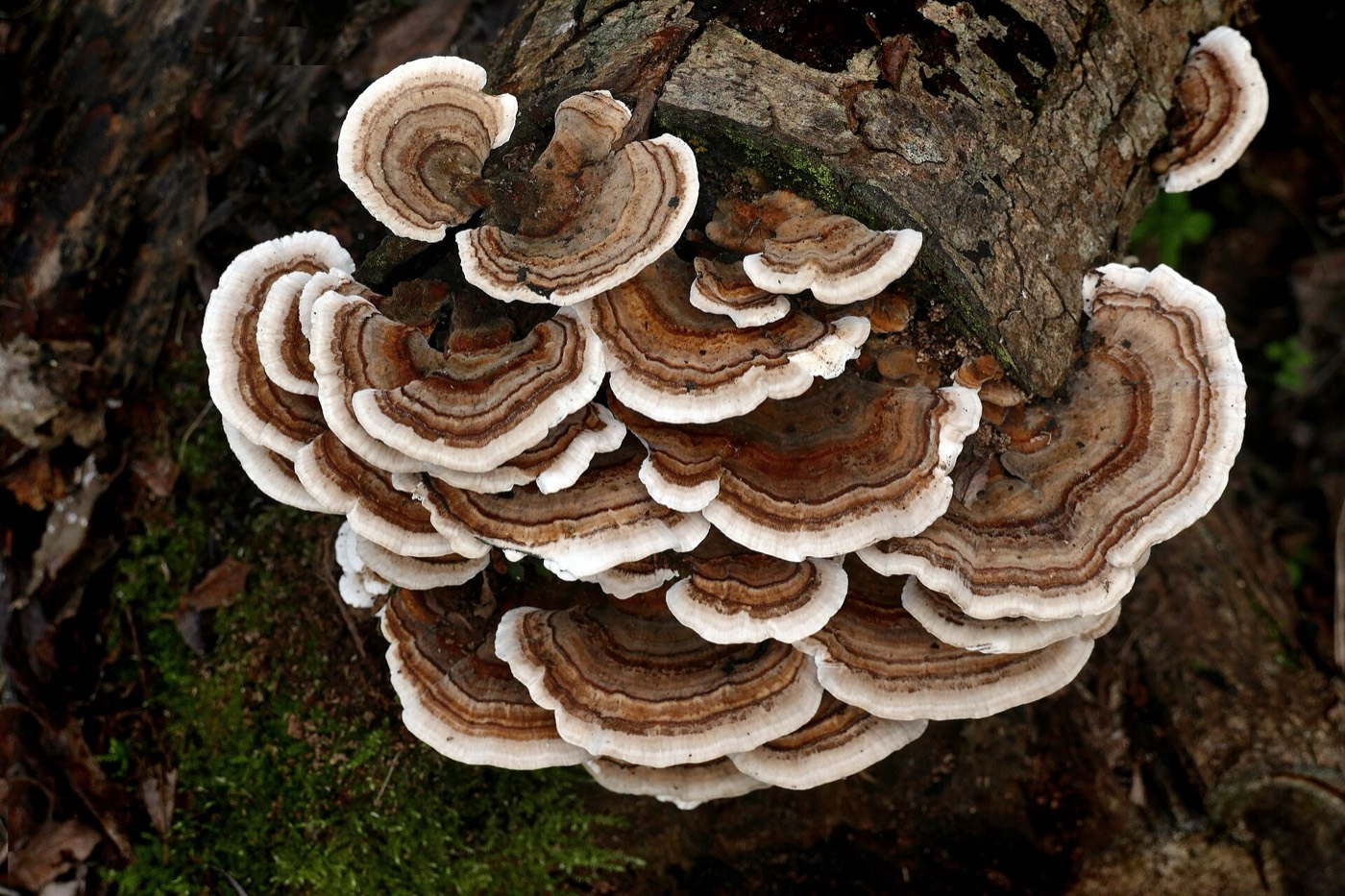
The cap, the bracket, the jelly, the crust on the underside of a fallen limb: these are spore factories. They are expensive, which is why they are timed. Many wood fungi fruit when the wood is wet enough to spare the water, and when the air is damp enough that spores will not simply die in the sun. A dry week with one spectacular mushroom is a worse predictor than a dull wet week with a flush of small ones. Turkey tail, the banded brackets of Trametes versicolor, is a white-rot fungus and a useful teacher because it is common, recognizable, and clearly attached to dead wood rather than to a living root. The bands of color are the surface. The work is the pale, soft wood behind them. If the wood under a supposed turkey tail is still hard and the pores on the underside are not there, you may be looking at a look-alike crust. The log is the identification, not only the stripes.
Spores are a numbers game. A single bracket releases more of them than you can usefully imagine, and almost none will land on a fresh wound or a fresh break at the moment the wood is open to colonization. The ones that do are racing the spores that landed yesterday. This is why the first fungi on a newly fallen tree are often fast growers on the remaining sugars, and why the lignin specialists come into a neighborhood that is already occupied. Succession on a log is not a moral story of improvement. It is a queue of diets, each one possible because the previous diet changed what is left.
What the insects are doing in the same wood
Fungi do not have the log to themselves. Bark beetles and other insects cut galleries, carry spores, and open paths that a hypha would have taken longer to find. Some beetles are tied to particular fungi so closely that the beetle is a dispersal organ and the fungus is a way of digesting a tree the beetle's own enzymes cannot handle. You do not have to name the beetle to use the observation. Powder on the bark, small round exit holes, and a fan of pale fungus in the gallery are a partnership you can record as "insect openings, fungus in the tunnels." That note will still be true when your identification skills catch up. Pretending you know the species when you know the pattern is how field notes go bad.
Later, when the wood is soft, a different set of animals moves in. Beetle larvae, millipedes, and the small predators that eat them turn fungal tissue and softened wood into frass. Boddy's point about nutrients leaving the fungal network when the mycelium is grazed, damaged, or dead belongs here. The cord system is not a permanent bank. It is spent when something eats it or when the wood it connects has been used up. A log that looks like a nursery for salamanders and beetle larvae in year six is the same log that was a hard pantry in year one. The animals are not a separate story from the rot. They are one of the ways the rot's gains get back into the soil.
The story about trees talking
It is easy, once you have seen cords and zone lines, to adopt the popular version in which trees send messages, warnings, and meals to each other through a fungal internet. Some of the underlying observations are solid. Carbon and mineral nutrients do move through fungal tissue. A mycorrhizal fungus really does connect more than one root. Boddy's saprotrophic cords really do relocate nutrients across the forest floor, often toward a new piece of dead wood rather than toward a grateful seedling. What is not solid is the idea that a tree composes a message and another tree reads it as a message. A fungus that moves carbon is balancing its own books. It feeds the roots that pay it, and it keeps a store for itself. If a shaded seedling receives a little carbon, the interesting organism may be the fungus, not a parent tree making a decision. Write "nutrients move through fungal cords" when that is what you saw or what the paper showed. Write "the trees were talking" only if you want a metaphor, and mark it as one.
The same caution applies to medicine and to foraging. Turkey tail is studied for its chemistry and it is also a tough, leathery bracket, not a meal. This article is about how wood is eaten. It is not a guide to what to put in a pot. A look-alike on a log is a bad place to be brave. The field skill worth building is recognition of the rot and the sequence, which you can practice without swallowing anything.
How to read one log
Choose a log you can visit again. Note the tree if you can, even if the note is only "oak, bark still in plates" or "conifer, no bark." Record whether it is still attached as a broken snag, freshly down with hard wood, or sunk into the litter. Look at the cut or broken end. Cubical brown crumb, pale fibers, or wood that still rings when you tap it with a knuckle: those are three different chapters, and the tap is enough. You do not need to dismantle the log. Prying it apart to see zone lines is a one-time lesson, not a habit. The beetles and the fungus were using the inside.
Then look for the announcements. Brackets on the side, crusts on the underside, small mushrooms from the soil line where the log stays wet. Photograph the underside of a bracket if you photograph anything. The pores, gills, or teeth are the part that separates groups, and the top color is the part that changes in the rain and fools people. Write the date and whether the week was wet. A fruiting body that appears three days after a soaking rain belongs to that rain in your notes. One that is dry, cracked, and clearly last season's should be labeled old, or it will distort your idea of the season.
Come back in another month and again in another year. The point of the second visit is the change in the wood, not a longer species list. If the cubes have collapsed and the moss has moved in, the brown-rot chapter is ending. If the log has flattened into the soil and tree seedlings are rooting in the remains, the pantry is closed. Seedlings on a log are not evidence that the fungus was farming for them. They are evidence that the unlock finally reached a stage roots can use, which is the end of the process Boddy described, not its purpose.
A year on the same trunk
In late winter a hardwood log that fell in the previous summer may still be hard, with bark tight and only a few pioneer crusts. Spring rain brings the first soft spots and, on some species, a flush of small fruiting bodies that will have vanished by June. Summer dries the outside. The inside of a thick log stays damp longer than the litter, which is why a midsummer visit can still find active mycelium under a surface that looks abandoned. Autumn rain is the reliable announcement season in much of the temperate woods. Brackets expand, turkey tail shows fresh pale margins, and the smell of the log changes from dry bark to sweet rot. Winter slows the visible growth and does not rewind it. A January visit is for seeing the structure: zone lines in a split you already opened, old brackets, insect holes, the shape of what is left.
None of those sentences is a promise for every forest. A dry pine woodland and a wet alder bottom do not share a calendar. They share the logic. Fresh wood, easy compounds, then a lignin or cellulose specialist, then animals and moss, then soil. Your notes should be local enough that a reader can tell which woodland you mean. "The log fruited" is not a note. "North end of the oak, underside brackets, two days after the October rain" is a note.
What not to tidy
People like to clear fallen wood because it looks untidy and because they have been told it is diseased. Some fungi do move from dead wood into living trees, and a fruiting body on a standing trunk can be a genuine warning about the strength of that trunk. A log on the ground in a wood is a different object. Removing every one of them removes the pantry, the cords, the beetle sequence, and the slow return of nutrients that a living root cannot take from lignin by itself. A garden is not a forest, and a trail has to be safe. A woodland managed as if every downed trunk were trash becomes a plantation of trunks with no middle chapter. If you are writing about a place, say whether the logs are still there. The fungi you list depend on that sentence.
The announcement will always be more photogenic than the work. Let the photograph be the bracket. Let the paragraph be the wood behind it: which rot, how wet, what the wood has become, and whether the same log was harder the last time you came. That is the whole natural history of a fallen tree, and it fits on a page if the page is willing to be about decay instead of about a prize.
Hardwood, conifer, and why the queue changes
Not every log offers the same meal. A hardwood like oak or beech carries more lignin in a different arrangement than many conifers, and the fungi that are common on one are often clumsy on the other. Pine and spruce logs in a dry stand can sit hard for a long time, resinous and slow, with a different set of brown-rot specialists. An alder or birch that falls into a wet spot can go from solid to the color of cheese in a few seasons, because the wood is softer and the moisture never really leaves. If your notes from a mixed wood lump these together as "fallen trees," the succession you think you are watching is several successions. Separate them by the bark you can still identify, and by whether the log lies in drainage or on a dry rise.
Resin and tannins are part of this delay. They are the tree's old argument with being eaten, and they keep working after the tree is dead. A freshly cut conifer stump that smells of pitch is a worse immediate meal than the broken, soaked end of a maple. Pioneer fungi still arrive. They just spend longer on the surface, in the wounds, before anyone is dismantling the heartwood. The practical sign is the depth of the soft layer. A finger's width of soft wood over a hard core means the queue has started and has not finished. A log that is soft all the way through has reached the chapter where animals and moss take over the structure.
Brackets, crusts, and the underside
A field key you can carry without a book is short, and it is about the underside. If the fertile surface is a field of tiny pores, you are looking at a polypore, the group that includes turkey tail and the large perennial brackets. If it is smooth or slightly wrinkled, you may be looking at a crust fungus, some of which are also serious wood rotters and some of which are only on the surface. If it has gills, it may be a mushroom that uses wood or a mushroom that uses the soil under the log, and those are different lives. Gilled mushrooms have spore prints, made by leaving a cap on paper overnight. Brackets with pores do not need that trick, and forcing one teaches you little. The pore surface, the way the bracket attaches, and the wood it is attached to are the characters.
Perennial brackets, the ones that add a tube layer each year, are a diary of a different sort. You can sometimes count layers in a cross section of a hard bracket such as a tinder polypore. That count is the age of the fruiting body, not the age of the infection, which started earlier, and not the age of the tree. It is still worth having, because a bracket with many layers means the fungus has held that spot through many seasons. A thin, fresh turkey tail with a pale growing margin means this season. Label them differently or your "fruiting calendar" will be full of last decade.
Carbon, soil, and the end of the pantry
What leaves the log as carbon dioxide is the part the fungus respired. What stays, for a while, is humus, insect frass, and the fragments of lignin that brown rot never fully finished. This is the unglamorous end of Floudas's story. The enzyme that opened wood to being eaten is also the reason a forest does not fill with permanent trunks. In a cool wet climate the return is faster and the soil is deeper in partly eaten wood. In a cold or dry climate the same log is a long-term store, and removing it removes a store the soil was going to receive slowly. Neither forest is "more alive" for the speed. They are on different settings of the same process.
You can watch the handoff at the soil line. Fungal cords leave the log, enter the litter, and sometimes enter a buried stick you would not have noticed. Seedlings rooted in the crumb are using a resource that has changed chemical class. Roots do not bite lignin the way a white-rot hypha does. They take up what the hypha, and then the grazers, have released. If you want a single sentence for the whole log, use that one. The mushroom is the announcement. The release is the point, and it is finished by organisms that will never appear in a photograph of the bracket.
Safety, standing trees, and the limit of tidiness
A fruiting body on a standing, living trunk is a different practical problem from a fruiting body on a log. It can mean the structural wood is being altered, and a trail, a road, or a house is a reason to take that seriously. The natural-history note and the hazard note should not cancel each other. Write "bracket at 2 meters on a living oak beside the path" as a hazard to mention, and also write what the wood is doing. A log twenty meters into the woods, supporting a salamander and a line of turkey tail, is not the same decision. People get into trouble when they learn one slogan, either "dead wood is waste" or "never cut a tree." The organism does not need the slogan. The path needs a judgment, and the judgment belongs in a sentence that names the place.
Leave the interior of the teaching log alone after you have learned what a zone line looks like. Every split is a dry-out and a loss of the moisture the fungus was using. You can learn the sequence from the outside: the tap of the wood, the color of the broken end, the kind of fruiting surface, the insects' holes, the moss, the year you first found it and the year it went flat. That is enough to read a forest. The announcement will keep being posted, on wet weeks, for anyone who arrives after the work has started.
How large the pantry actually is
Boddy and Watkinson were not writing a poem about fallen trees. In mature forest, by their account, dead wood is about 30 to 40 percent of the litter biomass that arrives in a year. That wood carries on the order of 1 to 4 kilograms of nitrogen per hectare per year, and about 0.1 to 0.8 kilograms of phosphorus. The numbers are a range for a kind of forest, not a weigh-in of the trunk you are standing beside. They are still the right scale. A log is a large fraction of the year's litter, and the scarce nutrients in it are locked in a form a root cannot spend.
What happens next is the part people skip because it is less generous. As the fungus respires carbon, the leftover wood looks richer in nitrogen and phosphorus. It is not a bowl left out for seedlings. Those nutrients are taken into mycelium. The fungus spends them on more foraging and on fruiting bodies, and it can move them many meters along cords toward another piece of wood. A sapling rooted in the crumb years later is meeting the end of a budget. It is not the reason the budget was kept. If your sentence says the log is feeding the young trees, name the organism that held the nutrients in between. In a wood with its fungi still in place, that organism is a fungus.
Telling the diets apart with your hands
Brown rot and white rot are different enough that a laboratory is a luxury. Brown-rotted wood cracks into cubes, reddish brown, and a cube powders under a thumb. The powder is the lignin the fungus did not take, left in a modified form. It is not yet soil. White-rotted wood is pale and stringy. Pull a wet piece and it separates along the grain. A log can show both, in neighboring blocks, with a dark zone line where the holders met. Record the face that is already open. Splitting a sound length of trunk to improve the picture dries the interior the beetles and the mycelium were using. One opened face, revisited, is a better series than a new wound every season.
Turkey tail belongs on the white-rot side when the identification is real. Banded top, often a pale margin while it is growing, pores rather than gills on the underside, and pale soft wood behind an established patch. A banded bracket on wood that is still hard, brown, and cubical is either a look-alike or a latecomer sitting on someone else's ground. The photograph in this article shows the bands people learn first. The identification is finished underneath, where the pores are, and behind, where the wood has gone pale. If you cannot see the underside, write "banded bracket" and leave the species for a day when you can.
What a second year is for
The first visit names a chapter. The second visit is the study. You do not need a percent. You need the same log and three comparisons. Is the broken end softer, unchanged, or still ringing when you tap it? Do the brackets have fresh pale edges, or only cracked caps from a previous season? Has moss crossed onto bark that was bare? Date those three lines. That is succession at a scale you can finish. A long list of names from one wet morning cannot answer the same question, because you will not know which names still matter when the wood has moved on.
Make the log findable in dull language. Which side of the path, which end touches the creek, which broken face you always check. If you come back and the log is gone, write that. Someone cleared it, a flood moved it, or it sank into the litter and you missed the low shape. Absence is a result. A notebook that only contains logs on picturesque days has the same bias as a bird list that only contains the best dawn in May.
A cord is not a root, and not a message
A cord you can see under loose bark is a bundle of hyphae. It is how a decay fungus searches for the next meal. A mycorrhiza is a fungus bound to a living root, trading with a plant that is still making sugar. Both can occupy one square meter, and that is why they get braided into a single story about a forest mind. They are not the same organ and not the same economy. The cord is spending a dead tree. The root fungus is attached to a tree that is still alive. If you cannot tell which strand you have, the honest words are "strand under bark" or "fungus on a fine root." The upgrade from those words to a conversation between trees is a change of subject.
Floudas's comparison of genomes sits at the start of this, not as a moral at the end. Wood lasts, and eventually becomes something like coal, until fungi can oxidize lignin. Brown rot and white rot are later diets built on that invention. Your log is one case in one climate. The Paleozoic is only the reason the case is allowed to finish. Write the case. Leave the planet-sized sentence for the citation, where it has the evidence attached.
Season belongs in the same restraint. A dry week can hide every fruiting body without pausing the rot inside a thick log. A wet week can cover a log with announcements from fungi that have been quiet for months. The calendar you want is the calendar of the wood's condition, with the fruiting written on top of it as weather. Swap those, and every rain becomes a new ecology. It is usually the same ecology, willing at last to be seen.