
A rocky shore looks like a picture of animals glued to stone. Stay through one tide and it becomes a timetable. The animals are not arranged at random, and they are not arranged only by what they "prefer." They are what remains after drying, waves, heat, and their neighbors have spent the day removing everyone else. The bands you see at low water are the record of that removal, written in barnacles, mussels, and algae from the spray down to the kelp.
T. A. Stephenson and Anne Stephenson compared rocky coasts far apart and argued that the stack repeats even when the species change. High in the splash, the organisms are those that can dry out and recover: certain barnacles, small snails, a black film of lichen or cyanobacteria. In the middle, where the tide covers and uncovers the rock on every ordinary cycle, mussels often take the space and hold it. At the bottom, uncovered only on the lowest tides, the rock belongs to kelps, red algae, and animals that do not survive a long morning in the air. Scotland, California, and Chile do not share a species list. They share the problem, and the problem makes bands.
The experiment that split the causes
Joseph Connell watched two barnacles and refused the comfortable explanation. Chthamalus adults live higher on the shore. They are capable of living lower. Lower down, a faster-growing barnacle overgrows them and crowds them out. Higher up, that faster neighbor dies of exposure, and Chthamalus is left with the rock. The upper boundary was physical. The lower boundary was another animal. A field guide that says each species "likes" its zone has stopped one step too early. Liking is what the survivors look like after the killing is done.
| Boundary | What sets it | Classic result |
|---|---|---|
| Upper edge of Chthamalus | Drying and heat | A physical limit, Connell 1961 |
| Lower edge of Chthamalus | A faster barnacle overgrows it | A biological limit, same study |
| Middle shore where stars hunt | Pisaster eats mussels | A mixed community, Paine 1966 |
| Middle shore, stars kept out | Mussels take the space | The band simplifies |
| What one visit can check | Hour, tide height, exposure | A sketch, not a new removal experiment |
Robert Paine pushed the same logic one step further with a predator. On the Washington coast he removed the ochre sea star, Pisaster, and kept it out. Mussels, which the stars eat, occupied space that had been a mix of species. The star does not eat the whole community one by one in the name of balance. It eats enough of the dominant space-holder that the dominant cannot take the entire middle shore. Where stars are scarce, the middle band simplifies. Where they are common, it stays crowded, and the lower edge of the mussels often falls near the depth the stars can still reach at high tide. You can see the signature without repeating the removal. A clean line of mussels, and a more mixed rock just below it, is a hypothesis you can write down and then test by watching where the stars actually are at high water.
Neither study says the shore is only biology, or only physics. Connell's upper limit was drying. Paine's mussels still die if a summer low tide strands them too high for too long. Waves decide which coasts can hold a mussel bed at all. A sheltered bay and a headland that takes the full ocean do not offer the same middle zone, even if the tide table is identical. When you describe a shore, name the exposure in the same sentence as the animals. "Mussels" on a protected wall and "mussels" on a surf bench are different facts.
A pool is not a small ocean
Tide pools tempt people because they hold still and the animals are visible. They are also the most misleading habitat on the rock if you treat them as the sea, only quieter. A pool high on the shore at noon in summer can be hot and much saltier than the ocean, because the sun takes water and leaves the salt. The same pool before dawn, full of algae that have been respiring in the dark, can be low on oxygen. Anemones close. Snails climb. Fish that were active at eight in the morning are gone, or gasping, at three in the afternoon. The species list without the hour is a list of animals that were present at one of those times and may have been unable to function at the other.
A pool lower on the shore is flushed more often and is a milder version of the same problem. The difference is the number of hours since the sea last entered, not a different kind of magic. If you can, write the time of the last high water next to the pool sketch. A pool you visit two hours after the tide left it is not the pool you would have measured five hours after. Temperature, salt, and oxygen move that fast. A notebook that records only names has thrown the measurement away and kept the souvenirs.
The animals are not passive while this happens. Mussels close and wait. Barnacles close the plates that make their shell a door. Some snails move up into crevices where humidity lasts. Anemones cover themselves with shell bits, which is partly a shield against light and drying and partly a way of looking like the gravel they sit on. These are behaviors you can see without an instrument. "Anemones closed, snails above the waterline, pool warm to the hand" is a real observation of a stressful noon. It will not match the field-guide photograph taken on a foggy morning, and it should not. Both photographs are the same shore.
Larvae, bare rock, and the month you cannot see
Most of the animals in the bands do not crawl there as adults and pick a neighborhood. They arrive as larvae in the water, settle, and then survive or do not. A bare patch is an opportunity only during the weeks when those larvae are in the plankton. Clear a rock in the wrong month, as storms sometimes do, and the first colonists may be algae or a barnacle, not the mussel that "belongs" in the picture you remember. Connell's barnacles and Paine's mussels are the outcomes of settlement plus survival, repeated every year. The band is stable in outline and unstable in membership. That is why a shore you knew five years ago can look the same from the cliff and different in the hand.
Storms edit faster than seasons. A winter swell can peel a sheet of mussels back to rock in an afternoon. The patch then belongs to whoever settles, and the mussels return from the edges and from new larvae on a schedule of years, not days. If you visit once, you will describe a community. If you visit after a storm and again in late summer, you will describe a recovery, which is more interesting and more honest. Write down the bare rock. It is not an empty observation. It is the start of the next experiment, which the sea is already running without your permission.
The tide table is part of the method
Bring a tide table and use it. A barnacle at chest height means one thing on a spring low tide, when you are looking at a level that is usually underwater, and another thing two hours before high water, when you are looking at a level that is usually in the air. People mislabel zones because they forget which tide they were standing on. "Low" is not a mood. It is a height relative to that day's water. If the low is not very low, you have not seen the kelp fringe, and you should not write as if you had. If the low is a good one, you are a guest in a place that will be underwater before lunch, and the note should be finished before you are.
Exposure time is the variable the animals feel. Stephenson's bands are, roughly, bands of hours out of water. You can approximate that without a gauge. Note the time the water left a particular mussel bed and the time it returned. That interval is the stress those mussels handled today. Repeat it on a hotter day and the same interval is a different stress. This is why a shore in fog and a shore in a clear noon are not replicates. Your page should say which one you had.
Neighbors you can lose by standing carelessly
A rocky shore is tough in the way a wave is tough, and fragile in the way a film of life on a stone is fragile. Turning every rock to see crabs dries the animals that were on the underside and crushes the ones you put the rock back on. Stepping on a mussel bed crushes the shells that were holding the space Paine wrote about. Collecting a "sample" of limpets from the high zone removes the grazers that keep that zone from becoming a film of algae. You can see the pattern without making a smaller version of a removal experiment by accident. Look, sketch, put a ruler in the frame if you need scale, and leave the stones where their animals arranged them.
The same restraint applies to tide-pool hands. Touching an anemone to watch it close is a trick the animal pays for with water and with the sting it spent. One touch will not empty a coast. A hundred visitors a day will change the pool that everyone came to see. If you are writing a public note, describe the close without recommending the poke.
What a single visit can still get right
You will not repeat Connell's years or Paine's removals on a Saturday. You can still come home with a page that is better than a species list. Draw the rock as a stack: splash, barnacle, mussel, algal fringe, and mark the height of the water while you were there. Name the time and the tide. Note one interaction you actually saw, not one you remember from a textbook: a star on a mussel, a snail above the pool, a patch of bare rock at the edge of a bed. Add the weather, because heat is part of the upper limit. That page can be compared with another Saturday. A list of Latin names cannot, unless the list also says where on the rock each name was allowed to live.
The shore will look like a picture again when you step back. The bands are genuinely beautiful, and there is nothing wrong with noticing that. The work is to remember that the picture is a result. Drying wrote the top. Neighbors wrote a lot of the middle. Predators wrote some of the boundaries. Larvae and storms keep editing the cast. The clock resets every tide, and the month resets the supply of new animals. Stand through one falling tide with the table in your pocket, and the rock stops being scenery. It becomes a machine you arrived in the middle of, which is the only honest way to arrive.
A falling tide, hour by hour
Suppose you arrive at high water on a moderate day, not a storm and not the lowest tide of the month. At first the rock is mostly underwater and the visible life is what can stand the splash: snails in crevices, a band of barnacles that the last waves still wet, and the black upper film that looks like stain and is alive. You cannot see the mussels yet. They are in the water, feeding, which is their actual job. The closed, patient mussel of the field guide is the mussel at low tide. At high tide it is open and working.
As the water drops a hand's width at a time, the barnacle band emerges and the plates close. This is Connell's upper world starting to feel the air. Snails that grazed underwater begin to clamp down or to move into damp cracks. If the day is hot, this is the hour when the high shore starts to pay. If the day is foggy, the same animals are hardly stressed and you will overestimate how "easy" the zone is. Write the sky down before you write the animals.
The mussel band appears next, a blue-black sheet with barnacles packed between and on the shells. This is the middle shore Paine showed could be simplified by removing a predator. Look for sea stars at the lower edge of the bed, often in the wetter cracks, not on the dry tops of the mussels. A star in a crack at the bottom of the bed is a more interesting record than a star in a bucket. Gaping mussel shells in a pile usually mean a recent predator or a recent heat kill. Intact closed shells mean the bed is waiting. Those are different events, and the shore is littered with people who record both as "mussels."
Lower still, if the tide is low enough, the algal fringe appears, slippery, darker, and full of animals that will not tolerate the barnacle zone's morning. Kelp holdfasts, small crabs, and the sponges or tunicates of a very low tide are a privilege of the calendar. If today's low water does not uncover them, do not invent them from memory of another coast. End the page at the water you actually reached. A partial stack is a true stack.
On the way back up, the same bands flood in reverse. Mussels open when the water returns. Barnacles begin to feed, the feathery legs reaching. The pool you measured at noon starts to be flushed and becomes ocean again. If you have the energy for one extra line, write the time the water reclaimed the mussel bed. The interval between leaving and returning is the exposure those animals just survived. That number, even as "about three hours," is better biology than a second photograph of a closed anemone.
Grazing, whelks, and the film on the rock
Limpets and snails are easy to treat as decorations in the barnacle zone. They are one of the reasons that zone is not a continuous garden of algae. A limpet scrapes the film of microscopic algae and the settling spores of larger seaweeds. Where grazers are dense, the rock stays open for barnacle larvae. Where grazers are removed, by a collection, a spill, or a season of heavy predation, a green film can take the space and change what is able to settle next. You can see the grazing trace as pale paths on a dark film, especially on a damp morning. The trace is enough. You do not need to pry the limpet off to prove it was feeding. Prying it off often kills it, because the home scar it returns to is a precise fit, and a displaced limpet on a drying rock is a limpet in trouble.
Dog whelks and other drilling snails eat barnacles and mussels by boring or by prying. A whelk on a barnacle is the same kind of fact as a sea star on a mussel: predation you witnessed, not predation you inferred from a clean zone. Empty barnacle shells in a patch can mean whelks, or heat, or a storm. If you did not see the cause, write "empty shells" and stop. Causes are cheap when you guess and expensive when you come back and the guess has hardened into a story.
Winter shores and summer shores
On a temperate coast the same height on the rock is a different habitat in January and in August. Winter exposure is cold, often wet, and physiologically expensive in a way that looks calm. Summer exposure is hot, and the upper mussel bed can die in a single cloudless low tide if the low water falls in the middle of the day. Those kills are part of the zonation, not exceptions to it. Connell's upper limit moves with the weather of the year. A band edge you sketch in April may be littered with dead mussels in September, and the dead mussels are the edge being rewritten. If you visit only in the pleasant month, you will draw the zone too wide.
Storm season adds the physical reset. A coast that is biologically sorted all summer can be sanded, scoured, or stripped in one week of onshore wind. The following spring is then a settlement story. Algae may hold for a season. Barnacles may recruit heavily. Mussels may take years to rebuild a sheet. Stephenson's "universal" bands are universal in outline and local in timing. Your notes become useful when they say which phase you caught. "Recovering, bare patches in the mussel line, barnacles dense above" is a phase. "Rocky shore" is a habitat label, and you already knew that from the map.
What to write when you are cold and the page is damp
Use a small set of lines you can finish before your hands quit. Place and date. Time, and whether the tide was falling or rising. Sky and a word for heat or wind. Then the stack from the top to as far as you went, one phrase each. Then one interaction seen. Then one thing that was missing and should not be invented: no kelp today, no stars seen, pool not measured. A page like that, repeated, will teach the clock. A longer page written from a cafe the next day will teach your memory, which is a worse instrument than the rock.
The machine does not pause between your visits. Larvae keep arriving on their own months. Stars keep eating at the lower edge. Heat keeps editing the top of the mussel bed on the afternoons you are somewhere else. The reason to write the hour and the tide is so that your thin sample can sit honestly inside a process that is not thin at all. You saw a slice. Say which slice. The bands will still be beautiful on the walk back up, and you will know, this time, who is waiting for the water and who is enduring the air.
The month has a clock too
A day on the rocks is the tide you stood through. The month is the beat of spring tides and neap tides, and it changes which band you are even allowed to see. Around the new moon and the full moon, the high water is higher and the low water is lower. In the quarters, the range shrinks. A Saturday that falls on a neap can feel like a full visit while never uncovering the algal fringe Stephenson would have counted as the lower shore. The animals have not vanished. The water has not gone away far enough. If your page does not say whether the low was a good one, a later reader will think the kelp zone was absent.
This is a number you can take from a tide table without pretending to be a hydrographer. Note the predicted height of the low, and note the time. Then note, honestly, whether you were still on the rock at that time or whether you left an hour early because of the wind. "Table said 0.2 at 11:40, I left at 11:10, water still covering the kelp" is a complete limitation. It is much better than a species list that implies you saw the whole stack. The table is part of the method because the zone is a height, and height on a shore is a time.
On many temperate coasts the dangerous low tides of summer fall in daylight, and the low tides of winter fall in the dark. That pattern is not a universal law, and you should read it off your own coast's table rather than import it. Where it holds, it is the reason a mussel bed can be killed by heat in one afternoon and merely chilled by a winter low that happens at night. Connell's upper limit is not a line painted on the rock. It is a set of hours out of water, made worse when those hours include noon sun. A sketch of the mussel line in April is a hypothesis about September. Go back, or do not talk as if the line were a property of the stone.
A profile you can draw in ten minutes
Stand at the side of the rock, not only on top of it, and draw a wedge. Top of the page is the black film and the spray. Then barnacles. Then the mussel sheet, if there is one. Then the wet algal fringe, if the tide let you. Mark the waterline at the minute you draw it, with an arrow and the time. You have just made Stephenson's stack into a picture of this tide rather than a picture of an ideal coast. Species names can sit in the margin afterward. If you only write names, you will not remember, next month, whether the mussels were a continuous sheet or a band with bare patches, and the bare patches are the interesting part.
Add exposure in the same sketch as a word, not as a measurement you did not take. "Open to the west, swell breaking on the point" is different from "inside the cove, water rising and falling with no white water." Paine's mussels and a mussel on a sheltered harbor wall are both mussels. The harbor wall may be concrete, which is a different settlement surface from the bedrock in the classic papers, and it may never see the wave force that rips a sheet off a headland. Say so. A note that pretends a jetty is a wilderness replicate will not survive contact with the papers, and it does not need to. It needs to be a true description of the jetty.
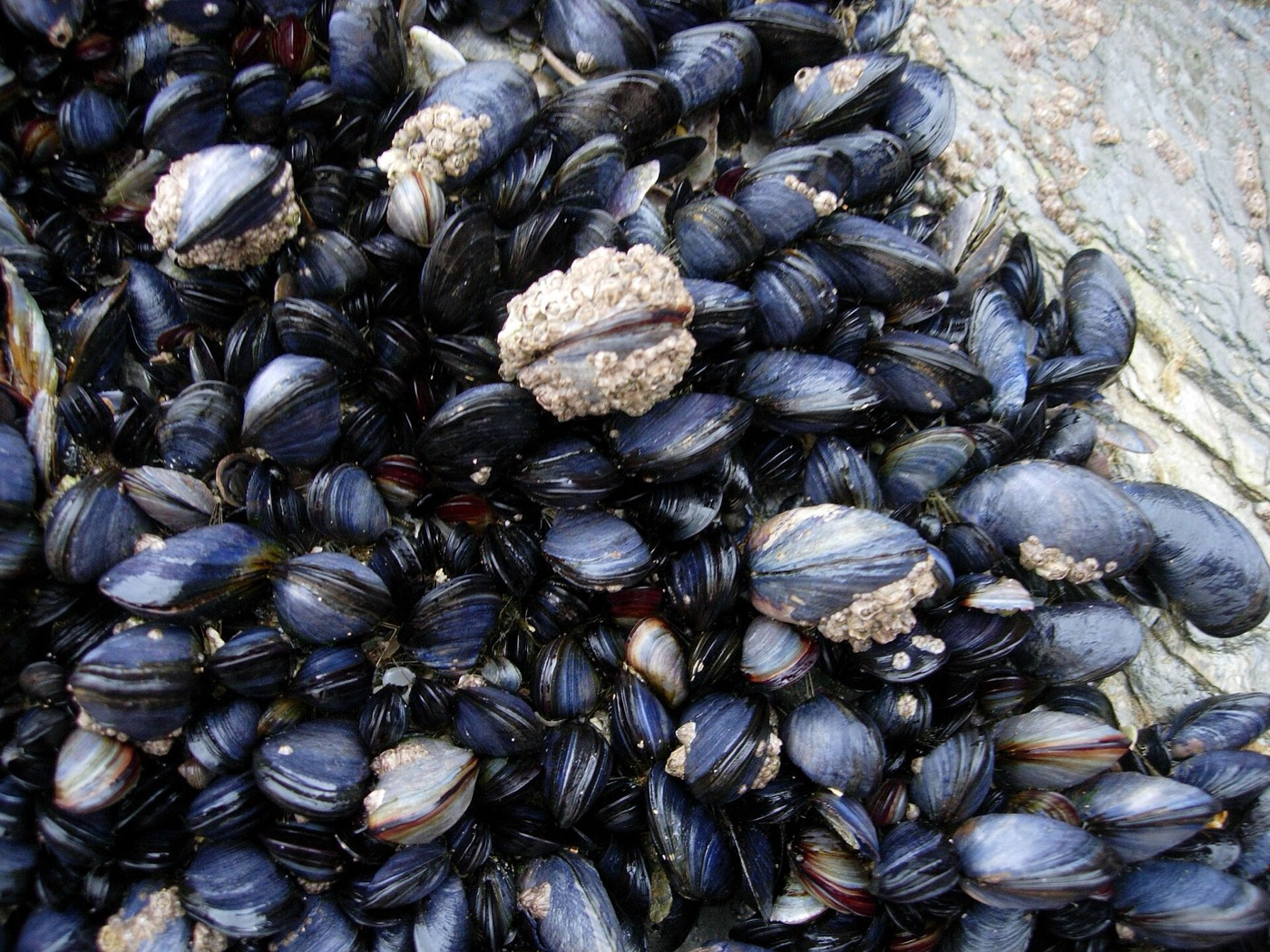
The photograph here is a mussel and barnacle shore in Cornwall, packed shells, barnacles on the mussels as well as on the rock. It is an example of the middle-shore crowd. It is not the Washington coast where Paine removed stars, and it is not Connell's Scottish barnacle zone. Use it to see what "a bed" means: almost no free rock, animals living on other animals, a surface that will crush if you step on it. Then go and see whether your own shore is a bed, a scatter, or a set of cracks with a few shells. Those are different communities that a single word, "mussels," flattens.
Heat, fog, and the hour the low water falls
Write the sky before you interpret a death. Gaping mussels in a band, still attached, on a hot clear day after a midday low, are a sign that the upper edge was rewritten by exposure. The same gaping shells after a storm may be torn animals, or animals a predator left. Empty barnacle plates can be a whelk, a heat kill, or last winter. If you did not see the hour it happened, the cause is a hypothesis and the shells are the data. Keep them in that order. A page that starts with the cause and then looks for shells to match it is a page that cannot be corrected by the next visit.
Fog is the control that makes the heat visible. The same height, the same hours out of water, under a wet fog, can leave anemones open and snails crawling. Under a clear sky those animals close and climb. If you only visit in kind weather, your "normal" zone is the easy version. Say what the air was doing. A single word is enough, and it makes two visits comparable. Without it, you will explain a biological difference that was a difference in the sky.
Pools need the same discipline, and the chart in this article is only a sketch of the direction of change. Temperature and saltiness tend to rise in a high pool through a sunny low tide, because water leaves and salt stays. Oxygen can fall overnight when the algae are not photosynthesizing, and it can swing the other way in bright afternoon weed. I am not giving you a salinity for a pool I did not measure, and you should not invent one either. "Warm to the wrist, no instrument" is a true note. A made-up number in practical salinity units is a fiction with a unit attached, which is worse than a blank.
What a class trip often breaks
A rocky shore teaches well, which is why it gets loved to death by the people who love it. Turning every stone to show a crab, collecting a pocket of limpets, stepping along the mussel sheet because the rock itself is slippery: each of these is a tiny removal experiment performed for an audience. Connell and Paine needed years and a careful hand to learn what a removal does. A Saturday group can do a sloppier version in an hour and learn less, because nobody writes down what was moved. If you are responsible for other people on a shore, give them the sketch and the tide table and a rule about stones. Lift nothing you cannot replace exactly, and replace it at once. The animals on the underside are there because it is dark and damp. They are not an exhibit that survives the lid being left off.
The same rule scales to what you publish. A public note that includes a precise location of a rich pool, plus an invitation to touch the anemones, spends a place so that strangers can repeat a trick. Describe the pattern. Leave the treasure map vague. The science does not need the GPS pin. The animals need the crevice.
You will leave with cold hands and an incomplete stack, and that is the correct yield of one tide. The shore has a daily clock, a monthly clock, and a yearly clock of storms and settlement. You stood inside one tick of the first. Write the tick. The bands will still be there next spring tide, edited a little by whoever settled and whoever was eaten, which is the only promise this habitat makes.