
A wetland at noon can look like a ditch with reeds. The same wetland, forty minutes before sunrise, is occupied. The difference is not that birds fly in for your benefit at dawn and leave to spare you the trouble of seeing them later. The difference is that the marsh has a schedule, and noon is a poor hour for reading it. If you want to know who lives there, you have to arrive when the animals are still declaring themselves, and you have to accept that many of them will be heard and not seen.
The dawn chorus is a timetable with a job. Territorial song peaks while the light is still too poor for efficient feeding and while the air is usually still. Sound carries farther before the wind rises and before the warmed ground starts to stir the reeds. Cynthia Staicer, David Spector, and Andrew Horn, reviewing daily patterns of bird sound, treat that peak as a signal: a bird tells its neighbors that it held the ground through the night, and it does so before the day's foraging begins. Later in the morning the same species may still sing, but the rate drops as insects become worth chasing and as the air gets noisier. Clive Catchpole and Peter Slater put the same behavior in the wider frame of bird song. Song is not surplus joy. It is territory, mate, and time of day, and the time of day is measurable.
What you are hearing when you cannot see
In a reed bed the chorus is also a method. A rail can call for ten minutes from inside cattails and never cross an opening. A bittern, a sora, a marsh wren: the stems are a wall, and the ear goes through it. A notebook that waits for a silhouette will record the heron and the blackbirds on the edge and will miss the birds that actually live in the interior. Give the calls their own column. "Heard" and "seen" are different kinds of evidence, and both are allowed. Pretending you saw a rail because the call was close is how a good morning becomes a bad list.
| Time | Easiest to record | Kind of evidence |
|---|---|---|
| Before sunrise | Wrens, rails, blackbirds | Mostly heard |
| Around sunrise | Song easing, herons at the edge | Heard and seen are different jobs |
| Later morning | Swallows, hawks, feeding ducks | Mostly seen |
| A windy dawn | Only the nearest singers | Not comparable to a still dawn |
| One Saturday | A single draw from the season | Not the marsh's list |
Herons and egrets make the rule clearer by breaking it. A great blue heron does not sing the boundary of a reed territory. It needs an edge where fish and frogs are moving, and it can strike once there is enough light to aim. You will often find the heron after the chorus has already peaked, standing in the ditch you walked past in the dark. The song and the hunt share the low sun. They are not the same activity. If your note says "lots of birds at dawn" and does not separate the singers from the hunters, you have averaged away the only pattern the morning offered.
Kingfishers, swallows, and the hawks that hunt the edge keep still other hours. Swallows follow insects that the warming air lifts. A marsh that was all voice at five can be all flight at nine, with fewer species calling and more species feeding in the open. Neither hour is the complete marsh. A survey that always happens at nine will be excellent on swallows and poor on rails. A survey that always happens in the dark of five will be the reverse. Write the hour down in minutes relative to sunrise, not as "early." Early is not a time.
Migration is a night you can miss
Wetlands matter on migration for a blunt reason. A small marsh can be the only shallow water and the only concentrated food along a long stretch of farm, suburb, or dry upland. Shorebirds and songbirds drop in, feed, and leave, sometimes between one dawn and the next. Milton Weller's account of wetland birds makes the practical point that is easy to skip because it is not romantic. The value of a marsh is not only the species that nest in it. It is also the species that use it for a night. A survey at noon in October, when those travelers are asleep in the grass or already gone, will undercount the place. A survey at dawn, on more than one day, will not.
This is also why a single famous morning is a bad description. A north wind in autumn can fill an impoundment with migrants overnight and empty the interesting part of it by the next afternoon. Calm Saturdays, which are when most people visit, are not a random sample of the door. If you can only come on Saturdays, come early, and come on more than one Saturday before you decide the marsh "has" a list. The list is a rate. One visit is a draw from it.
Water level moves the door as much as wind does. A drawdown that leaves mud flats will bring shorebirds and send some ducks elsewhere. A high water that floods the flats will do the opposite. The birds did not change their nature between your two visits. The habitat you offered them changed by a few centimeters. A note without the water level is a note that cannot be interpreted in April, when you are trying to remember why the sandpipers were there in September. "Mud to the ankle at the south end" is enough. "Good for birds" is not.
How to stand so the marsh can still be heard
Arrive before the chorus, not during the peak you hope to catch. The walk in should be finished while it is still too dark to see color, so that your noise is over before the birds begin. Stand, or sit, and let the list build for a fixed time. Ten minutes of standing will beat forty minutes of walking if the goal is to hear rails. Walking has a different goal: the heron in the next ditch, the sparrow on the berm, the bird that will not call while you are on top of it. Do one, then the other, and do not mix the minutes. A traveling count and a standing count are different tools, and adding them into one number called "species" pretends they were the same effort.
Keep the wind on the page. Song carries poorly into a breeze, and a windy dawn is not comparable to a still one even if you were equally skilled and equally awake. Temperature belongs there too, because a cold still morning and a warm still morning do not start the insects, or the feeding, at the same minute. You are not trying to become a weather station. You are trying not to explain a quiet marsh with the wrong cause. Quiet because of wind is not quiet because the rails have left.
Do not use playback as a way to enlarge the list. A recorded call can pull a secretive bird into view, and it can also pull it off a nest or spend the energy the song was supposed to save. A public note that recommends broadcasting calls into a reed bed is a note that trades the marsh for a better photograph. Hearing the bird where it chose to sing is the observation. Dragging it out is a different activity, and it does not belong in a careful account.
Nests, edges, and the birds of the afternoon
Noon still has birds, and they are worth a second page so that you do not pretend dawn is the only truth. Blackbirds on the cattail edge, a harrier quartering the grass, swallows over the open water, the heron that has been standing since the light got good: these are the marsh with the lights on. Young birds in late summer make this hour louder than the breeding dawn was, because begging calls and clumsy flights happen in the open. A July noon and an April dawn are both the same wetland and they should not be averaged. Label them. The person who reads your notebook next year, who may be you, will not remember which mood you were in. They will remember what you wrote next to the date.
Nesting evidence deserves plain language. Carrying food, alarm calls that follow you and then stop at a patch of reeds, a bird that will not flush from one spot: these are reasons to suspect a nest and reasons to leave. They are not reasons to part the cattails. A marsh wren's nest is a ball in the stems that the wren can rebuild and that a boot can end. Record the behavior at the distance the bird started calling. That distance is part of the note, because it tells a later reader how close the activity was willing to be.
What a season of dawns adds up to
Four visits will not make you an authority. They will do something more useful. They will stop you from describing the marsh as the first morning you happened to like. A March dawn of red-winged blackbirds and a few early swallows, a May dawn with wrens and rails and the heron hunt after sunrise, an August morning of young blackbirds and migrating sandpipers on the mud, an October dawn that is either full or empty depending on the wind: those are four marshes. Weller's point sits underneath them. Count the residents and the visitors separately in your mind, even if you cannot always tell a migrant from a local sparrow. A place that only "has breeding birds" in your notes has lost half its job. A place that only "has migrants" has lost the other half.
The skill that grows is not a longer life list. It is a better ear for three or four common voices and a stricter habit with the clock. Learn the red-winged blackbird until you can separate it from everything else without thinking. Learn the marsh wren. Learn one rail. Learn the difference between a heron lifting off and a duck lifting off, which you can do with your eyes closed after a week because the wings sound nothing alike. Everything else can stay "unknown call, two notes, from the dense cattail" until you know it. An unknown with a time and a place is data. A guessed name is noise.
Write the minutes before sunrise, the wind, the water, and whether the bird was heard or seen. Those lines are the whole method. The rest is standing still long enough to let a place that hides its animals give them away. Noon can wait. The marsh will still be there, looking empty, which is its way of saying you have come at the wrong hour.
Four voices worth learning before any others
A marsh has more species than you will learn this year. It does not have more species than you can start. The red-winged blackbird is the edge: the song is broadcast from a cattail, the red shoulder is the confirmation when the light arrives, and the bird will still be there on an ordinary day. Learn it so thoroughly that it becomes the background and not the prize. The marsh wren is the interior: a long, rattling, mechanical song from deep in the stems, often with no view of the singer. If you can separate that rattle from every blackbird and sparrow, you have a resident that noon surveys miss. A rail, whether sora or something rarer you are not ready to name, is the call that comes from the mud under the stems, one or two notes, repeated. Write the pattern. Do not upgrade it to a species because a list on your phone suggested one.
The great blue heron is the control, because it is the bird the method is not built for. You will see it, usually after the chorus, usually at the edge, usually hunting. If your morning is only herons and mallards, you walked the edge and you heard little. That is allowed. It is a different sample. Say so, and do not pad it with rails you almost heard. Mallards and other dabbling ducks add a fifth, optional voice, the one that lifts off the open water with a whistle of wings. They tell you about the open water, not about the cattail interior. A complete beginner who can separate blackbird, wren, rail-like call, heron, and duck has the structure of the marsh. Everything else is refinement.
The year in a temperate marsh
Late winter is ice, or mud and a few ducks, and it is worth one visit so that you know what empty sounds like. Early spring is blackbirds claiming the edge, often before the reeds have grown back. This is the easiest dawn of the year and a bad one to use as the standard, because the interior singers have not started and the migrants are only beginning. Late spring is the full chorus: wrens, rails, blackbirds, and the heron hunt once the light allows it. If you only learn one month, learn this one, and then distrust it as a portrait of the whole year.
Summer is young birds, fewer territorial songs, and more traffic in the air. The marsh can sound busy and be, in terms of the dawn chorus, already winding down. Early autumn is the door Weller emphasized. Shorebirds on mud, warblers in the edge shrubs for a morning, swallows gathering, and then a quiet that means the residents are all that remain. Late autumn and the start of winter belong to ducks and to whoever stays. A notebook with one page from each of those seasons will outperform a notebook with ten pages from the single May when the weather was kind.
Do not invent counts to make the seasons look scientific. "Wren song constant from one patch, blackbirds from the edge, no rails in ten minutes" is a count of a sort, an effort-based presence. "Approximately forty-three wrens" is a fiction unless you have a method that could actually separate forty-three birds. Presence, effort, and time beat false precision. The marsh is not impressed by a number you could not have collected.
Sound, inversions, and the reason dawn is loud
Still air is only part of why the chorus carries. At dawn the ground is often colder than the air just above it, a temperature inversion, and sound that would have spread upward can bend back down and travel farther along the marsh. Staicer's review and the acoustic literature treat this as one reason a song at five is a better advertisement than the same song at ten, when the ground has warmed and the breeze has started. You cannot see the inversion. You can hear its practical result: a wren that is still inside the reeds is suddenly a wren you can locate from the berm. An hour later the same bird may be singing and you will not pick it out of the rustle. If you conclude that it stopped, you may only have lost the highway the sound was using.
Wind ruins the highway. So does your own walking. A group that talks along the dike will record the species that tolerate people and will call the rest absent. The fix is dull and complete. Talk at the car. Be quiet before the light. Let the ten minutes be ten minutes. The birds were going to sing anyway. The variable you control is whether you are a noise source in the middle of the sample.
What you owe the nest
Breeding season is when the method most easily becomes harassment. A rail that calls is not an invitation to enter the cattail. A heron that flushes from a rookery is a heron that may leave eggs in the sun. You do not need a close photograph to write "heron hunting, south ditch, after sunrise." You do need to leave if alarm calls focus on you and stay focused. The bird is spending the morning on you, which means it is not spending it on food or on the nest. Back up until the calls stop, and write the distance as the distance at which the bird relaxed, not the distance at which you got the best view.
Playback, already a bad habit, is worse here. A recorded wren song can make a wren cross territory lines and spend displays it needed for the actual neighbor. The list gains a checkmark. The marsh loses the morning you were trying to study. If a bird will not show itself, the honest record is the call. Future you does not need the picture. Future you needs the time and the place and the certainty that you did not invent the view.
Ice, drawdown, and the visits that feel like nothing
Some of the most useful mornings are the ones that feel like a mistake. A frozen marsh with one song sparrow and the sound of your own feet is a baseline. Without it, every later abundance is floating. A drawdown day with shorebirds and no wrens tells you the interior is dry enough to reorganize. A high-water day with ducks in the grass and no mud tells you the flats have been cancelled. None of these is the poster morning. All of them explain the poster morning, which usually happened because the water was at one particular height and the wind was not.
Write the disappointing visit at the same length as the exciting one. One paragraph is enough: date, minutes from sunrise, wind, water, what you heard, what you did not hear in the ten quiet minutes. The season is made of these paragraphs. A marsh described only on its best day is a marsh you do not know. The birds are keeping the other days too. The notebook should be allowed to hear them.
A bird you did not detect is not a bird that left
The hardest sentence in a marsh notebook is the one that stays inside the effort. "No rails in ten minutes of standing" does not mean the marsh has no rails. It means that in that window, at that wind, from that spot, you did not hear one. Secretive birds have detection probabilities well below one, which is a formal way of saying the cattails are good at their job. If you convert every silence into an absence, your season will be a map of when you were lucky. Write the minutes, the place you stood, and the wind. Future you can then tell a quiet morning from an empty marsh, which are different facts and which feel the same at the time.
This is also why a walking count and a standing count must not be added. Walking flushes the heron and the ducks and misses the rail that stopped calling when your boots hit the berm. Standing hears the rail and never sees the sparrow that was behind you. Both are legitimate. Their totals are not one total. If you only have room for a single number, do not invent a combined richness. Keep the lists in two short columns, heard from the standing watch, seen on the walk, and let them disagree.
Apps that name a bird from a recording are a tool with a known failure. They are confident in the wrong voice, they miss the bird under the bird, and they do not know your marsh. Use one if you want a suggestion, and then write what you heard in your own words: "long rattle from the cattail, suggestion wren, not confirmed by eye." A suggestion marked as a suggestion is data about you and the bird. A suggestion copied down as a sighting is how error gets into a year of notes and becomes, by repetition, a "population."
Song, call, and the heron that does neither
Catchpole and Slater's frame is worth using on the berm, not only in a lecture. Song, in the strict sense, is the loud, structured advertisement: territory, mate, the dawn peak Staicer and colleagues reviewed. Calls are the shorter sounds of contact, alarm, flight, and begging. A marsh wren's long rattle on a territory is song. The sharp note a blackbird gives when you pass is a call. Mixing them into "the birds were vocal" erases the timetable, because song stacks up before sunrise and calls continue whenever the birds are busy. If you only score "vocal, yes," noon and dawn look alike.
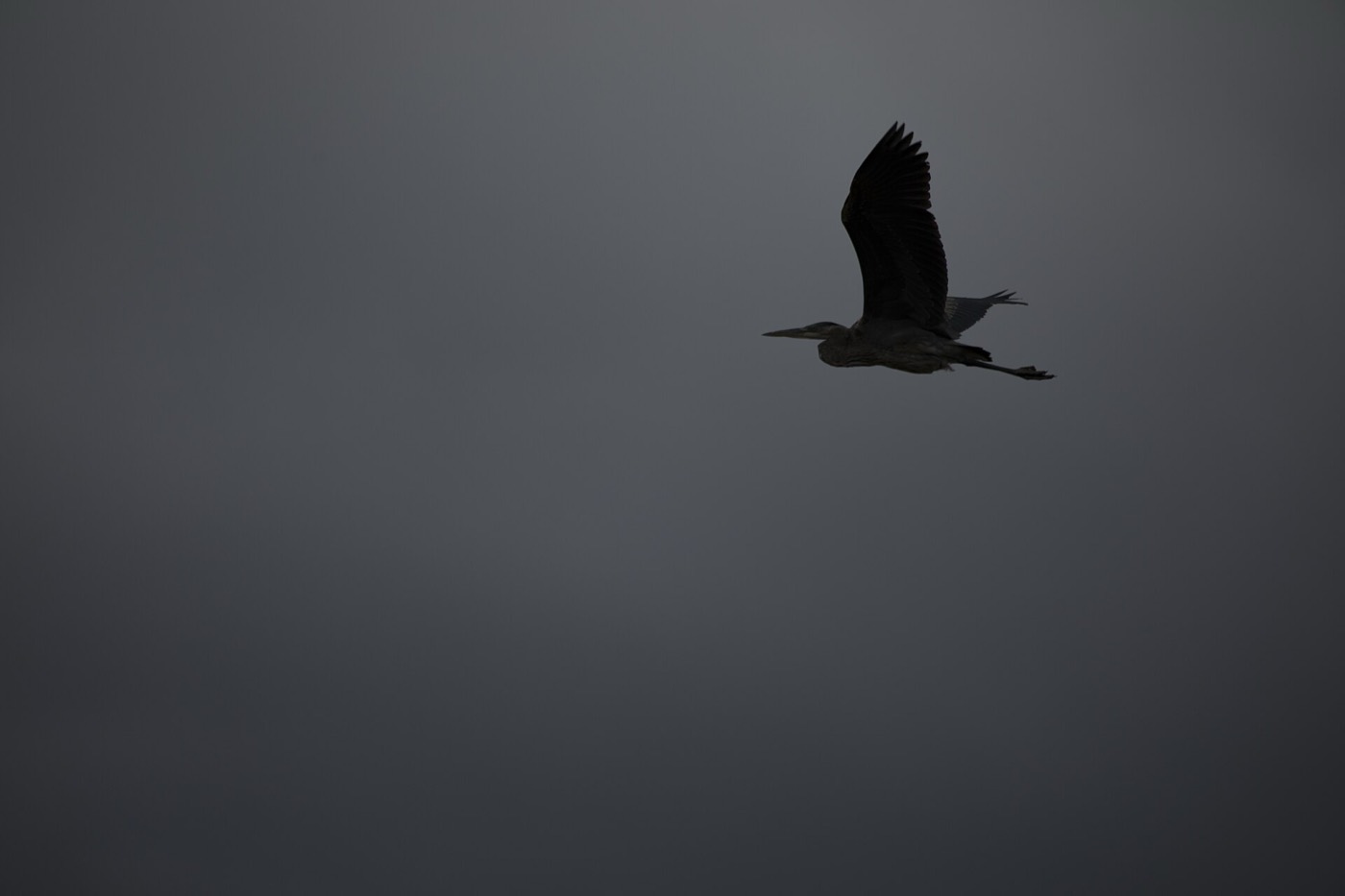
The great blue heron is the control species because it refuses the song clock. It hunts by eye, so it wants light, and the interesting record is the strike or the stillness, not a phrase. You will often add the heron after the chorus has peaked, on the walk out. That order is the pattern. A morning with herons and mallards and little song is a walk along open water. A morning with wrens and rails and no heron is a standing watch in the reeds. Neither is the whole wetland. The photograph in this article is a heron in poor light, almost a silhouette, which is the honest picture of the hour when you can hear the marsh and can barely see the hunter. Do not brighten the method to match a field-guide plate taken at noon.
A page that is a template, not a count
Here is a shape that fits on a damp card, with nothing in it that pretends to be a census from a marsh I am not standing in. Date and place described so you can return. Minutes relative to sunrise, not the word early. Wind in a word, and water in a phrase: ice, mud to the ankle, flooded grass, drawdown flats. Then a standing watch of a fixed length. Then, separately, a walk. Under the watch, name only the voices you will defend, and keep a line for unknown calls with the pattern: "two notes, repeated, from deep in the stem." Under the walk, the heron, the ducks, the swallows, or the lack of them. One line for what you did not do: no playback, no entry into the cattail, left when alarm focused on you.
Repeat the card. Four cards from four seasons will teach you more than a single heroic dawn with forty names, half of them uncertain. Weller's point should be visible in the stack of cards even if you never write his name in the field. Some birds are using the marsh to breed. Some are using it to stop. The cards from May and the cards from September should not look the same, and if they do, either the marsh is unusual or you are only detecting the residents who sing the loudest. The second explanation is the one to rule out first, by going at the right hour and by writing the silences at full length.
Night migrants and the mornings after
A great deal of migration happens at night, and a wetland at dawn is sometimes the place those birds have just landed. You may hear flight calls overhead before it is light, a thin traffic that is not the territorial chorus at all. You do not have to name those calls for them to change the morning. "Flight calls overhead, then a new set of chips in the edge shrubs that were not here yesterday" is a stopover note. It matches the reason Weller gives for valuing even a small marsh: it is a door, not only a home. If you sleep through that hour and arrive at ten, the door may already have closed, the birds moved into cover or departed, and the marsh will look like the residents only.
Weather decides whether you should expect that door to be busy, and you should write the weather without inventing the birds. A front, a north wind in autumn, rain that grounded a flight: these are reasons to be on the berm, not reasons to write a large number you did not count. The chart with this article is a sketch of when voices are easiest and when the heron's hunt becomes possible. It is not a graph of a survey. There are no flock sizes in it. If you need a number, use the number you actually collected, which is the length of the watch.
The marsh at noon is still worth the second card, once the first card exists. Otherwise noon becomes your picture of the place, and the place is better at hiding than you are at walking. Arrive before the light. Stand. Separate heard from seen. Leave the nests alone. Do that often enough that a quiet morning is allowed to be a quiet morning, and the wetland stops being a ditch that sometimes has a heron. It becomes a schedule you were finally on time for.