
A red maple does not blush because the night was cold. Cold can speed the last act, and a hard frost can cancel it. The decision to take the leaf apart is made earlier, on a clock made of night length. Once you watch one tree through that clock, autumn stops being a postcard and becomes a procedure. The tree is emptying a leaf, saving what is expensive, and only then letting the leaf go.
Chlorophyll is the expensive green. It catches light, and while it is abundant it hides every other pigment in the leaf. As nights lengthen, a deciduous tree begins an orderly retreat. Chlorophyll is broken down. Nitrogen and other useful pieces are pulled back into the twigs and the trunk before the leaf is allowed to fall. Johan Keskitalo and colleagues followed aspen cells through this season and found a timetable rather than a collapse. Photosynthesis declines on a schedule. The green fades on a schedule. The cells dismantle structures in an order. The leaf falls at the end of the order, not at the beginning. An early hard frost cuts the sequence short. That is when leaves brown and hang, or drop while they are still dull. The frost did not paint the hill. When it arrived too soon, it prevented the painting.
Yellow was already there
When the green thins, carotenoids become visible. They are the yellows and the oranges, and they were in the leaf all summer, working in the light reactions, covered by chlorophyll. A yellow leaf is often a leaf that has stopped hiding what it already owned. No new construction is required for that color. The tree spends the season taking chlorophyll apart, and the yellow is what remains in view. Ginkgo, tulip tree, many birches, and a good number of hickories run this cheaper reveal. They can be brilliant. They are not doing the same chemical job as a red maple.
| What you see | Pigment or habit | Where it comes from |
|---|---|---|
| Green through summer | Chlorophyll | Built for the season, then broken down |
| Yellow in autumn | Carotenoids | Already in the leaf, uncovered when green thins |
| Red in autumn | Anthocyanins | Made during senescence, not stored in the twig |
| Brown overnight | Timetable cut short | Frost or drought before the export finishes |
| Brown leaf that hangs | Marcescence | Common in oaks and beeches, a different habit |
Red is a separate expense. Anthocyanins are made in autumn. They are not uncovered like the carotenoids. The tree spends carbon on a new pigment at the same time that it is trying to empty the leaf, which looks wasteful until you ask what the leaf still has to survive. While nitrogen is still being exported, the leaf is still catching light and is less able to use that light safely. Bright days and cold nights are exactly the combination that damages a half-shut photosystem. David Lee and Kevin Gould have argued, from years of work on these pigments, that the red screen limits the damage, both by shading the tissue and by mopping up reactive molecules. Marco Archetti and colleagues set the main ideas side by side: a sunscreen for a leaf that is still recovering nutrients, a signal to insects looking for a place to lay eggs, or a side effect of sugar trapped behind a sealing layer. The protective idea has the widest support. The insect-signal idea is interesting and not required to explain why a sunny cold week makes better reds than a warm cloudy one.
A tree that drops its leaves while they are still green has abandoned the groceries. That happens when drought, salt, or a sudden frost ends the timetable early. The ground is then littered with leaves that still hold nitrogen the tree could have kept. Gardeners sometimes treat this as a moral failure of the tree. It is an interrupted procedure. The brown oak leaf that hangs until spring is a different strategy again, common in some oaks and beeches, and it is not a red maple that failed. Tannins and a slower abscission layer keep those leaves on the twig. Write the species. A sentence that says "the trees turned" cannot be compared with anything next year.
The clock is the night
Day length, or more precisely the length of the uninterrupted night, is the cue that starts the retreat in many temperate trees. A warm September can slow the visible color. It does not, by itself, move the calendar as much as people think, because the nights have already been lengthening since June. A cold snap in early September can damage leaves without being the reason they were going to change. The experiments that sort these causes are not something you can repeat on a roadside tree, but the pattern you can record is simple. Note the date of the first changed leaves, the date when about half the crown has changed, and the date when the crown is bare. Do the same tree next year. If a warm September delayed the middle date, your two years will show it. If you only remember that "it was pretty late," the years are lost.
Keskitalo's aspen timetable is the cellular version of those three dates. Chlorophyll content falls over weeks, not overnight. Photosynthesis falls with it, but not always in perfect step, because a leaf can still be green enough to look alive and already be a poor solar panel. Anthocyanin, in species that make it, rises while the export is underway and then disappears when the leaf drops, because the pigment goes with the leaf. It is not stored in the twig. The twig stores the nitrogen. This is why a pile of red leaves is not a pile of saved nutrients. The save already happened, or it did not. The color on the ground is the part the tree decided it could spare.
One tree is a better instrument than a hillside
Hillsides are where people go because the color is concentrated and the road has a pull-off. They are a poor instrument. A hillside mixes species, ages, wet feet, and dry feet, and it mixes trees that started on time with trees that a fungus or a drought pushed early. Pick one tree you can find again. A roadside red maple, an oak at the edge of a wood, a single aspen in a yard. Give it a name in your notebook that is not poetic. "Maple at the mailbox" will still mean something in November of next year. "The flame" will not.
On that tree, separate the crown into a few zones if you can do it without climbing. The top often changes before the shaded interior. Leaves in full sun are the ones most exposed to the bright cold afternoons that favor anthocyanin. Shaded leaves may yellow and drop with little red, on the same tree, in the same week. A photograph of the sunny side will lie about the shaded side. Walk around the trunk once and write what the back is doing. That single extra sentence is the difference between a postcard and a note.
Flowers belong in the same book with the arrow reversed. Swelling buds, first open flower, first full leaf, and, for a shrub that flowers before it leafs, the gap between those dates. A shrub that opens flowers on bare wood is racing. The leaves will soon shade the display, and the pollinators are already flying. The race is won or lost on a few days. People who record only the peak flower miss the start, and the start is the date that moves when the spring is early. Use the same individual. A lilac at the door and a lilac in a photograph from a park are not a time series.
Weather that helps the procedure, and weather that breaks it
The famous autumn is cool nights, sunny days, and enough soil water that the tree is not already dropping leaves in August. Sun gives the light stress that red pigment answers. Cool nights slow the export just enough, and keep sugar in the leaf, which favors anthocyanin. Soil water lets the procedure finish instead of aborting. A drought year can color early and thinly, or it can brown the margins before any red appears. A week of warm rain in October can mute a maple that was on its way. None of these is a reason to skip the note. They are the note. Write the week of weather next to the three dates, in ordinary words. "Hard frost on the 4th, leaves still green, brown by the 6th" is a complete story of an interrupted timetable.
Do not average a town. Trees on a wet creek bank and trees on a thin roadside soil are not replicates. The creek tree may still be green when the roadside tree is bare, and both are responding to water as well as to night length. If you have only one tree, stay with it. If you have three, label them by the soil they stand in. The comparison will teach you more than a drive to a famous overlook, and you can make it on a weekday.
What the leaf is not saying
Color is not a health score you can use from a moving car. A red maple is not healthier than a brown oak. A tree that colors early is not necessarily dying, although a tree that colors months early, in July, often is stressed and deserves a closer look at the trunk, the roots, and the soil. Insects, salt from a road, a girdling root, and a compacted parking strip all push leaves off the timetable. The way you tell a stressed individual from a punctual one is the comparison with its own previous years, or with a neighbor of the same species in better soil. One red crown in August among green maples is a question. A whole street turning in October is the season.
There is also no prize for the reddest species. Lee and Gould's point is functional, not aesthetic. The pigment costs carbon. Species that pay the cost are solving a light problem during senescence. Species that yellow are solving the nutrient-recovery problem without that extra screen, which is a reasonable solution in shade or in climates where the bright cold afternoons are rare. Your notebook can hold both without ranking them. Rank is what a tourism board does. Timing is what the tree does.
A year, if you actually keep it
Start in late winter, before you care about color. Note buds. In spring, note the first flower and the first full leaf on the same individuals you will watch in fall. Through summer, one line a month is enough: full canopy, any early yellow, any dead branch. In September, start the three dates. In November, write the date the crown is bare and whether leaves are on the ground, still red, or already brown. In December, stop. The point of the empty months is that they keep you from opening the notebook only when the tree is performing.
After two years you will have something that a single beautiful weekend cannot supply. You will know whether this maple starts at the top, whether the oak beside it ever really reddens, and whether a warm September moved the middle date. Keskitalo's cells and Archetti's hypotheses will still be in the papers. Your tree will be a check on the part of those ideas that reaches the street: that autumn is a shutdown with a clock, that red and yellow are different expenses, and that frost is a hazard to the procedure rather than the painter. The leaf is not dying of a cold night. It is being emptied, on a schedule, and then let go. The notebook is just you, paying enough attention to see the schedule twice.
Night length is an old discovery, and trees use it
The idea that day length runs a plant's calendar is older than the autumn-color arguments. Garner and Allard, in 1920, showed that flowering in some crops depends on the length of the day rather than on a vague sense of the season. Trees are not soybeans, and the papers on bud set and leaf senescence have their own experiments, but the principle you can carry to a street tree is the same. The plant is measuring the night. A warm week does not rewind the clock. It can only change how fast the visible steps proceed once the clock has started them. This is why a mild October does not keep a maple green forever, and why a cold week in August does not, by itself, turn a healthy crown red. The night has to be long enough. The weather decides whether the procedure, once started, looks brilliant or looks bruised.
You can see the measuring, crudely, in the fact that street lights sometimes confuse a nearby branch. A limb that sits in a lamp's light all night may hold green leaves longer than the rest of the crown, because the uninterrupted dark never arrives. It is not a controlled experiment, and the lamp is also warmer, so do not over-claim it. It is a hint you can write down: "branch nearest the lamp still green, rest of crown half red." If the pattern repeats next year on the same branch, you have a neighborhood demonstration of photoperiod. If it does not repeat, you have a coincidence, and the notebook should be willing to say so.
The cut that lets the leaf go
Color is the visible middle of the procedure. Abscission is the end. Across the base of the petiole the tree builds a separation layer, a band of cells that come apart, and a seal on the twig side so the wound does not stay open. The leaf falls. The seal stays. Next year's bud is often already waiting above that scar. When people say the tree is dying in autumn they are looking at the organ the tree meant to discard. The twig is the part that continues, with the nitrogen recovered and the bud already formed. A scar you can see with a hand lens, a small crescent or ring where the leaf was, is the signature of a finished procedure. A broken, torn petiole is the signature of a storm or a frost that did not wait for the layer.
This is worth one line in the notebook on the day the crown becomes bare. Leaves released cleanly, or leaves torn, or leaves still hanging brown. Those three endings match the three ways the season can close: on time, by weather violence, or by the marcescent habit of oaks and beeches that keep the dead leaf on purpose. Mixing them into "fall happened" deletes the ending, and the ending is half the evidence that a timetable was running.
Species you can separate without a key
You do not need a complete flora to keep a useful autumn book. Red maple and sugar maple both redden, and if you cannot separate them yet, write "maple" and learn the leaves later rather than guessing. Oak, if it is the brown or russet kind common in many towns, is your example of a tree that often skips the red expense. Aspen or cottonwood, where you have them, yellow early and cleanly and are the closest street version of the Keskitalo timetable. Ginkgo turns a uniform yellow and drops, sometimes in one storm, which is a spectacular version of the carotenoid reveal and a poor example of anthocyanin. Larch, if a larch is nearby, is a conifer that bothers to be deciduous and turns gold. One individual of each, labeled, will teach the categories in the pigment table better than a mixed hillside where you cannot find the same crown twice.
Write the soil in three words. Creek bank, compacted verge, or lawn with irrigation. Irrigation is a hidden September rain. A maple that is watered all autumn is not on the same water clock as a maple in a dry parking island, and their color dates will differ for a reason that has nothing to do with night length. If you do not note the sprinkler, you will invent a climate story for what is a hose.
A page for each of the three dates
Give each date its own short entry so that later you cannot blur them. First color: which part of the crown, which pigment as far as you can tell, what the rest of the crown is still doing. Half color: the date you would defend if someone asked when the tree "turned," plus the weather of that week in a single line. Bare: the date, the state of the leaves on the ground, and whether the twigs sealed cleanly. Three short entries beat one emotional paragraph written at the peak. The peak is the part you will remember anyway. The start and the end are the parts the timetable is made of, and they are the parts a postcard never includes.
In spring, reuse the page. First flower and first full leaf, on this tree or on the shrub you paired with it. A complete individual year then reads: bud, flower, leaf, full canopy, first color, half color, bare. Seven lines. The articles and the arguments about anthocyanin sit underneath those lines and do not replace them. Lee and Gould explain why the red line might be costly and useful. Archetti sorts the competing reasons. Keskitalo shows that the cells follow an order. Your seven lines show whether this particular plant, in this particular soil, ran the order this year or was interrupted. That is as close as a notebook gets to the science, and it is close enough to be worth doing twice.
The leaf is going to fall whether you watch or not. The only thing the watching changes is whether you can tell, next October, if the clock moved. Everything else, the red and the yellow and the brown oak that refuses to perform, is the tree emptying what it grew, on a schedule set by the length of the night, and then letting the empty leaf go.
One aspen, one autumn, a real timetable
The street-tree method needs a laboratory version so you can see what "a timetable" means when someone actually measured it. Johanna Keskitalo and colleagues followed a free-growing aspen in northern Sweden through the autumn of 2003. Senescence on that tree started on 11 September, and they judged the start to be the photoperiod, because the process then ran steadily without an obvious push from other signals. Leaves did not load anthocyanin at the beginning of September. After senescence had begun, they did, when conditions favored photo-oxidative stress. The dismantling of leaf contents took about eighteen days. By 19 September chlorophyll had fallen by about half, and mitochondrial respiration was supplying the energy to pull nutrients back. Remobilization seemed to stop around 29 September, likely because phloem transport itself was ending. The last leaves fell over the following week, and even then some cells were still alive, with chlorophyll left in the aged plastids.
Those dates are that tree, that year, at that latitude. They are not the dates for a red maple in a mild city, and copying "11 September" onto your mailbox maple would be a costume, not a replicate. What you can carry home is the order. A start that is not a frost. A stretch of weeks, not a weekend. A point where the leaf is only half as green and is already spending stored energy to finish the export. A stop to the export before the last leaf drops. Anthocyanin as a response during the process, not as the process. Your three field dates, first color, half color, and bare, are the coarse version of that order. If a frost browns the crown in a night, you have the interrupted version, and you should say so instead of calling it peak color.
What is recovered, and what is thrown away
The point of the eighteen days is the nitrogen, not the postcard. Chlorophyll is broken down and useful pieces are pulled back into the twig. The red pigment, in species that bother to make it, is built in the leaf during this window and then leaves with the leaf. It is not a store the tree draws on in spring. Yellow carotenoids were in the leaf all summer and simply become visible. A pile of red and yellow leaves on a lawn is the material the tree decided it could spare, plus the pigments that were never the cargo. Raking them is a garden question. It is not the tree losing the savings. The savings, when the timetable finished, are already in the wood.
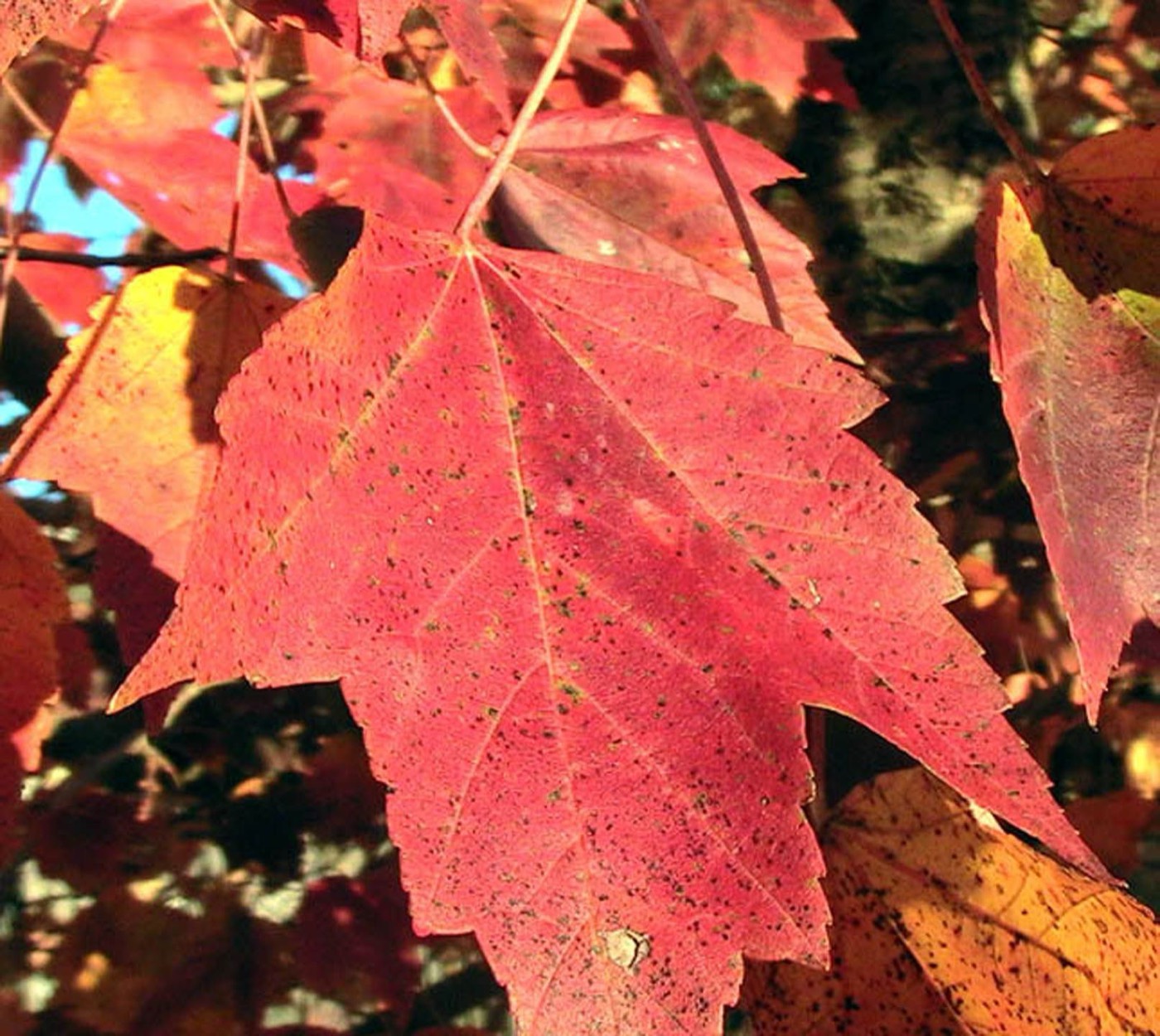
You can see the ending on the twig if you look on the day the crown goes bare. A clean abscission scar means the separation layer formed and the seal was made. A torn petiole means wind or a freeze won the race. A brown leaf that stays until spring, the habit of many oaks and beeches, means the tree never meant to drop it on the maple's schedule. The photograph of a red maple leaf is the middle of a maple's version: red from anthocyanin newly made, the green already failing, the yellow of uncovered carotenoids visible on neighboring leaves in the same frame. It is one species at one moment. It is not "autumn" in general, and the spots and wear on a real leaf are a reminder that a leaf at the end of its life is a working organ under stress, not a piece of colored paper.
A year written as seven lines
Keep the template small enough that you will still fill it in a year when you are busy. Bud, in late winter. First flower, if the plant flowers where you can see it. First full leaf. One summer line, canopy intact or already damaged. First color, with the part of the crown and a guess at the pigment. Half color, the date you would defend as the turn, plus the week's weather in a phrase. Bare, with the scar or the tear or the hanging brown leaf. Seven lines on one individual. The papers sit under the lines. They do not replace them, and they do not ask you to invent a chlorophyll percentage for a tree you measured with your eyes.
If you want a second individual, make it a different pigment strategy, not a second maple. An oak that russets and hangs, a ginkgo that goes yellow and drops in a storm, an aspen that yellows cleanly and is the closest street cousin of the Swedish timetable. Label the soil in three words, including whether a sprinkler runs, because irrigation is a hidden rain and it will move the dates for a reason that has nothing to do with night length. Garner and Allard's day-length result was about flowering in crops. Mention it as the principle, that plants measure the night, and do not pretend a soybean and a maple are the same experiment. The street lamp that holds one branch green is a hint of that measurement. It is also warmer than the night around it. If the branch repeats the trick next year, keep the note. If it does not, strike the theory and keep the observation.
Color is a schedule, and a schedule can fail
A crown that turns in July, while its neighbors of the same species are green, is a question about roots, salt, insects, or a trunk injury. A street that turns together in October is the night length, plus whatever weather the procedure met. Lee and Gould's argument for anthocyanin is a function during senescence, a screen and a quench while the leaf is still recovering nutrients in bright cold light. Archetti's review lines that idea up beside the insect-signal idea and the side-effect idea. You do not have to pick a winner in the notebook. You have to avoid the sentence that says the leaf turned red because the air was cold, as if cold were a dye. Cold nights and sunny days can make the red brighter once the timetable is running. A frost before the timetable has run can end it in brown. Both sentences can be true, and they are not the same sentence.
The chart with this article is a sketch of that shape across the months: green high through summer, red rising only after the retreat has started, both gone when the leaf is on the ground. It is not Keskitalo's measured curve, and it does not belong to a single maple I watched. It is the order, drawn so the order is harder to forget than a paragraph. Your tree, dated, is the observation. The order is what makes the observation mean something in a second year, when you can finally ask whether the clock moved, or whether the weather only changed the costume the clock was wearing.